


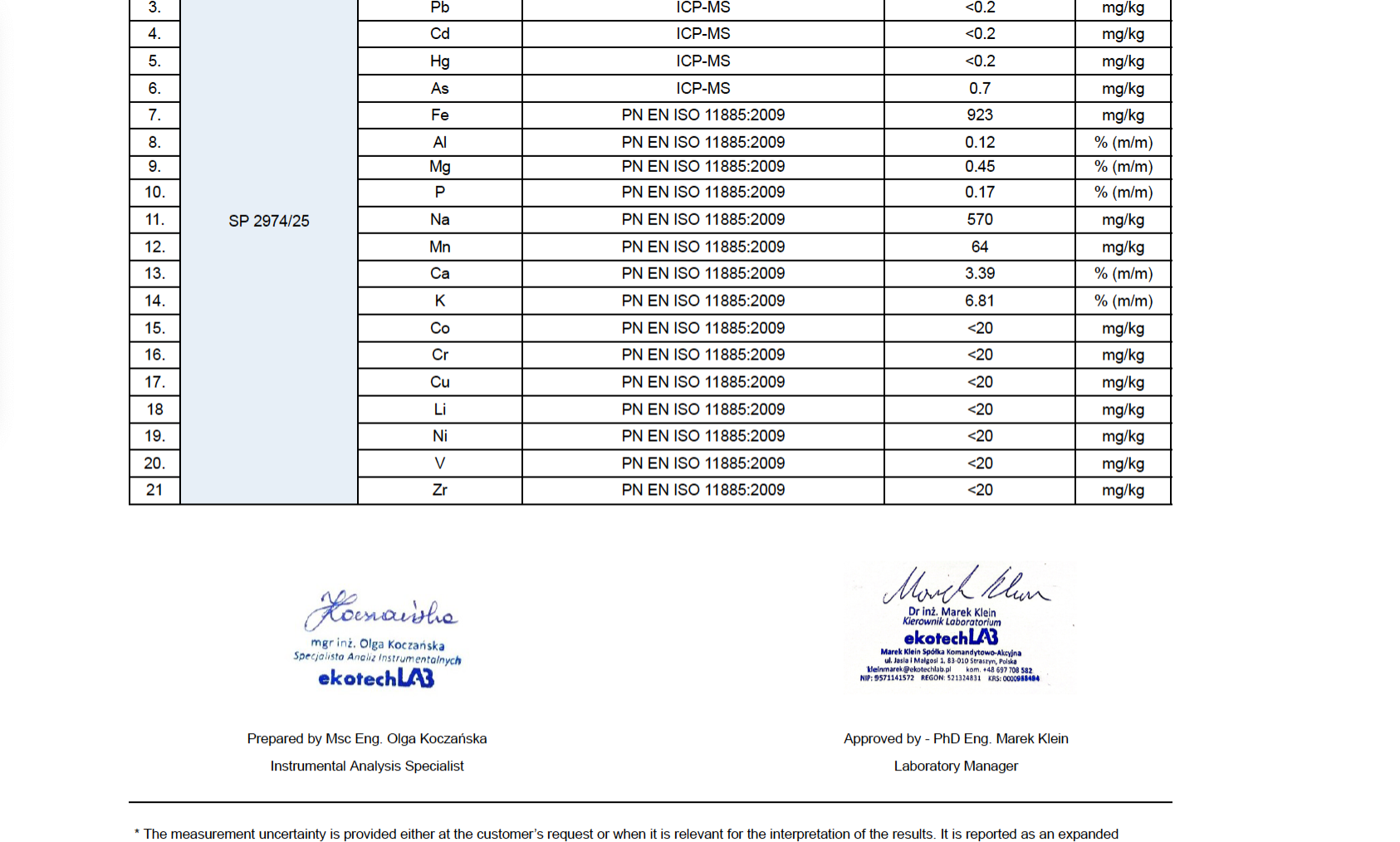
The supplement industry loves a laboratory report.
Scroll through enough Shilajit websites and you'll see certificates, analytical reports, certificates of analysis (COAs), heavy metal tests, fulvic acid percentages and enough scientific terminology to make most people's eyes glaze over.
The message is usually quite simple:
"Look, we have a lab report. Therefore, our Shilajit must be good."
Unfortunately, it isn't always that simple.
A laboratory report can provide genuine evidence of quality, purity and safety. It can also be misleading, incomplete or based on testing methods that don't tell the full story.
Quick Answer: How Do You Read a Shilajit Lab Report?
When reading a Shilajit lab report, start by identifying who performed the testing, which analytical methods were used, whether heavy metals were measured, and whether the results can be traced back to a specific sample. Pay particular attention to how fulvic acid was analysed. A large percentage alone tells you very little unless the testing method is clearly stated. In many cases, the method used to generate a result is more important than the result itself.
The presence of a well-known laboratory name does not automatically mean every test on that report is accredited.
And a large fulvic acid percentage does not automatically mean a superior product.
Whether you're buying Siberian Shilajit, Altai Shilajit, Hunza Shilajit or any other form of mineral resin, understanding how to read a lab report can help you separate meaningful evidence from clever marketing.
Why Shilajit Lab Reports Matter
Unlike many supplements, Shilajit is a naturally occurring substance.
Its composition can vary significantly depending on:
- Source region
- Altitude
- Geological conditions
- Processing methods
- Purification procedures
This means quality cannot simply be assumed.
A laboratory report should help answer some important questions:
- Is the product safe?
- Does it contain heavy metals?
- What is the mineral composition?
- How much fulvic acid does it contain?
- How much humic acid does it contain?
- How were these values measured?
The last question is often the most important.
What Is a Shilajit COA (Certificate of Analysis)?
A COA, or Certificate of Analysis, is one of the most common documents you'll encounter when researching Shilajit products.
In theory, a COA provides independent evidence that a product has been tested and that the results match the manufacturer's claims.
A good COA should clearly show:
- Product identification
- Testing laboratory
- Testing dates
- Analytical methods
- Results
- Signatures or approvals where applicable
However, not all COAs provide the same level of transparency.
Some contain comprehensive testing data and clear methodology. Others may provide only selected results or omit important details regarding how the analysis was performed.
A COA should be viewed as a starting point rather than a guarantee. The real value lies not only in the results themselves, but in understanding how those results were obtained.
The First Thing to Check: Who Performed the Testing?
Before looking at any numbers, look at the laboratory itself.
A credible report should clearly identify:
- Laboratory name
- Laboratory address
- Contact details
- Report number
- Laboratory references
This might sound obvious, but many reports shared online are cropped, partially obscured or stripped of important information.
A result without context isn't particularly useful.
The more transparent the report, the easier it becomes to evaluate.
Understanding Laboratory Accreditation
One of the most common terms you'll encounter is ISO 17025.
What Is ISO 17025?
ISO/IEC 17025 is the international standard used to assess testing and calibration laboratories.
It demonstrates that a laboratory operates under recognised quality systems and has demonstrated competence in performing specific analytical methods.
In practical terms, this means the laboratory has:
- Appropriate equipment
- Validated procedures
- Quality control systems
- Calibration protocols
- Competent personnel
- Traceability procedures
However, this is where many consumers become confused.
A laboratory can hold ISO 17025 accreditation while still performing some analyses that are not accredited.
Accreditation applies to specific methods within a laboratory's approved scope.
Not every test performed by an accredited laboratory is necessarily accredited.
This distinction matters.
Can You Identify the Sample Being Tested?
A trustworthy report should clearly identify the sample submitted for analysis.
This may include:
- Product description
- Sample identification number
- Customer information
- Laboratory reference number
- Testing dates
The purpose is simple.
Consumers should be able to see that a real sample was submitted, analysed and reported.
The more information provided, the easier it becomes to verify the authenticity of the report.
What Was Actually Tested?
Many Shilajit reports provide only a single figure, usually fulvic acid.
While fulvic acid is important, it only tells part of the story.
A more comprehensive report may include:
- Fulvic acid
-
Humic acid
- Heavy metals
-
Mineral profile
- Moisture content
The more information available, the better equipped consumers are to assess quality.
Understanding Common Laboratory Terminology
Laboratory reports are full of abbreviations and technical language.
Here are some of the most common terms you'll encounter.
ICP-MS
Inductively Coupled Plasma Mass Spectrometry.
One of the most sensitive analytical techniques available for detecting metals.
Commonly used for measuring:
- Lead (Pb)
- Cadmium (Cd)
- Mercury (Hg)
- Arsenic (As)
If you're looking at heavy metal testing, ICP-MS is generally a very good sign.
LOQ
Limit of Quantification.
The lowest concentration that can be reliably measured.
The lower the LOQ, the more sensitive the analysis.
LOD
Limit of Detection.
The lowest concentration that can be detected, even if it cannot be accurately quantified.
BLQ
Below Limit of Quantification.
The substance may be present, but below the laboratory's ability to accurately measure it.
For contaminants, this is usually what you want to see.
Dry Matter
The percentage remaining after moisture has been removed.
This is particularly important when analysing Shilajit because moisture content can significantly affect percentage-based calculations.
Moisture Content
The amount of water present within the sample.
Products with higher moisture content can appear weaker when active compounds are expressed as percentages of total weight.
The Most Important Part of Any Shilajit Report: The Method
This is where many consumers go wrong.
They focus entirely on the number.
Scientists focus on the method.
And for good reason.
A result is only as reliable as the method used to produce it.
Every analytical report should clearly state:
- What was analysed
- Which method was used
- How the result was obtained
The method often tells you more than the number itself.
The Problem with Fulvic Acid Testing
If you've spent any time researching Shilajit, you've probably noticed brands competing to advertise the highest possible fulvic acid percentage.
40%.
50%.
60%.
Sometimes even higher.
The problem is that very few brands explain how those numbers were generated.
And that's where things become interesting.
Not All Fulvic Acid Tests Measure the Same Thing
One of the most common approaches used for fulvic acid analysis is UV-Vis spectrometry.
It's fast.
It's inexpensive.
And it's widely available.
Unfortunately, it also has significant limitations.
UV-Vis does not directly identify fulvic acid.
Instead, it measures light absorbance at specific wavelengths.
The problem is that numerous organic compounds absorb light in similar ways.
These can include:
- Humic acids
- Polyphenols
- Tannins
- Degraded plant compounds
- Other organic material
As a result, the method can produce fulvic acid values that appear substantially higher than the true concentration.
The result looks impressive.
That doesn't necessarily mean it's accurate.
Why Some Fulvic Acid Numbers Can Be Misleading
When non-specific methods are used, apparent fulvic acid values can be significantly overstated.
Industry observations suggest that some methods may overestimate:
- Fulvic acid by 20-50%
- Humic acid by 10-30%
This means a product claiming 50% fulvic acid may not actually contain 50% genuine fulvic acid when measured using more rigorous analytical procedures.
This doesn't automatically mean the product is poor quality.
It simply means the analytical method matters.
A lot.
The Gold Standard: ISO 19822:2018
When it comes to humic substances, including fulvic and humic acids, the most widely recognised procedure is ISO 19822:2018.
Unlike rapid screening techniques, ISO 19822 physically separates humic and fulvic fractions before quantification.
This process, known as fractionation, removes much of the interference that can affect simpler analytical methods.
In practical terms:
Some methods estimate.
ISO 19822 measures.
That distinction is one of the reasons we use ISO 19822:2018 when analysing our Shilajit products.
Not All Laboratory Branding Means the Same Thing
Another area that often causes confusion is laboratory branding.
Many consumers see a large laboratory name on a report and assume every result has been produced using accredited methods.
Unfortunately, that's not always the case.
Large laboratory networks frequently subcontract specialist analyses to third-party laboratories.
This is common practice and isn't necessarily a problem.
The important question is whether the specific analysis itself is accredited.
Some reports may carry the branding of a major laboratory while certain analyses have been performed externally using non-accredited methods.
This is why it's important to read the footnotes rather than simply focusing on the logo at the top of the page.
Don’t Ignore the Small Print
Most consumers spend their time looking at the headline results.
Scientists often spend their time looking at the footnotes.
Why?
Because that's where you'll frequently find some of the most important information on the entire report.
The small print may reveal:
- Whether a test was accredited
- Whether an analysis was subcontracted to another laboratory
- Which analytical method was used
- Any limitations of the testing procedure
- How the results should be interpreted
In some cases, the footnotes tell a very different story from the headline figure.
For example, a report may display a large fulvic acid percentage on the front page while the notes reveal that the analysis was performed using a non-accredited method or subcontracted to a third party. That doesn't automatically mean the result is wrong, but it does provide important context that consumers should understand.
This is particularly relevant when reviewing Shilajit reports. Many consumers focus entirely on the fulvic acid percentage while overlooking the method used to obtain it, the accreditation status of the analysis, or any limitations noted by the laboratory.
It's also worth remembering that laboratory reports are typically written by scientists, not marketers. The footnotes exist for a reason. They provide context, qualifications and technical information that help ensure the results are interpreted correctly.
So before you get excited about a big number in the middle of the page, take a moment to read the small print underneath it.
You might discover that the most important information on the report isn't the result itself, but the explanation that follows.
Internal SOP Codes: What Do They Actually Mean?
Sometimes you'll see a method listed as something like:
EASI-CHE-SOP-71
or another internal laboratory code.
SOP stands for Standard Operating Procedure.
These are internal laboratory methods used by individual organisations.
The challenge is that consumers cannot independently review these procedures.
Unlike recognised international standards such as ISO 19822:2018, internal SOP methods are not publicly available.
This doesn't automatically mean the analysis is inaccurate.
It simply means there is less transparency surrounding exactly how the result was obtained.
A method code is not the same thing as an internationally recognised analytical standard.
Red Flags to Watch For
When reviewing a Shilajit lab report, be cautious if you notice:
- No testing method listed
- No laboratory details
- No dates
- No approval or signature
- Extremely high fulvic acid claims with no explanation of methodology
- Heavy metal claims without actual results being shown
- Reports that only display selected pages
- Laboratory branding being used as a substitute for methodological transparency
None of these automatically prove a report is inaccurate.
However, they should encourage further questions.
Questions Every Consumer Should Ask
When reviewing any Shilajit lab report, ask yourself:
- Who performed the testing?
- What analytical method was used?
- Is the method accredited?
- Are heavy metals shown?
- Is humic acid reported alongside fulvic acid?
- Can the testing method be independently verified?
- Are the results signed and approved?
If you cannot answer those questions, it becomes increasingly difficult to evaluate the reliability of the results being presented.
If you'd like to learn more about how Shilajit quality is assessed, you may also find these guides useful:
- How Shilajit Testing Actually Works
- Heavy Metals in Shilajit: Context, Concern and Clarity
- How Much Fulvic Acid Should Shilajit Contain?
- What Are Dibenzo-Alpha-Pyrones (DBPs) in Shilajit?
- What to Look for When Buying Shilajit
Together, these articles explore the testing methods, quality markers and common misconceptions that often shape the way Shilajit products are marketed and compared.
The Bottom Line
A laboratory report should provide evidence, not simply reassurance.
The laboratory matters.
The method matters.
The accreditation matters.
And sometimes the most important information isn't the number itself, but how that number was obtained.
A trustworthy company shouldn't simply tell you what the result was.
They should be willing to explain how that result was obtained, what the method means and what the limitations are.
Because when it comes to Shilajit, understanding the testing method can tell you far more than a headline fulvic acid percentage ever will.
Share:
Informal Tests vs Lab Reports: Why Most Shilajit “Authenticity Checks” Don’t Mean Much
How Much Should Shilajit Cost? Understanding Price, Quality and Value