


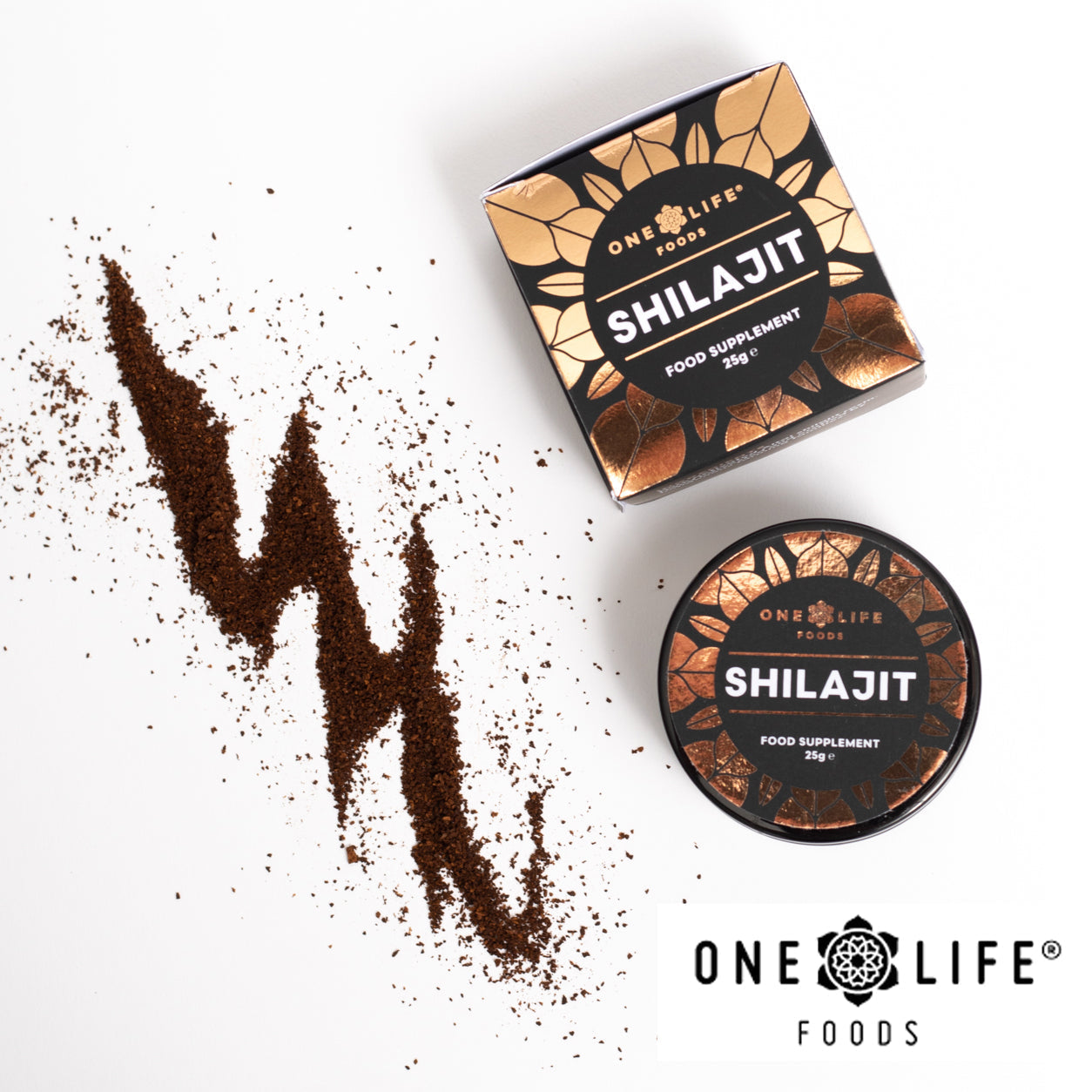
Quick answer: what is Shilajit?
Shilajit is a naturally occurring organic-mineral substance found within certain mountainous rock systems.
It is thought to develop over very long periods as biological material is gradually broken down, transformed and humified within mineral-rich environments.
It is not a single compound.
It is a complex natural matrix containing fulvic compounds, humic substances, trace elements and numerous smaller organic components.
Its composition varies according to the source material, local geology, environmental conditions, purification and testing method.
Its quality therefore depends less on romantic origin claims and more on:
sourcing
purification
composition
testing
batch-to-batch consistency
A simple starting point
The simplest way to understand Shilajit is this:
it is a natural, resin-like mountain exudate formed through the long-term transformation of biological material within rock environments.
It is usually collected from cracks, seams and fissures, where it may appear as a dense, dark and sticky material.
But Shilajit is often misunderstood because people try to reduce it to one thing.
A fulvic acid percentage.
A mineral count.
A mountain range.
A colour.
A texture.
None of those tells the full story.
Shilajit is a complex natural material, and that complexity is exactly why sourcing, processing and testing matter.
Is Shilajit a plant, mineral or resin?
Shilajit is sometimes described as a plant substance.
Elsewhere, it is called a mineral.
Most products simply call it a resin.
None of those descriptions is entirely wrong.
None is complete either.
Shilajit is best described as an organic-mineral matrix.
The organic fraction is thought to originate largely from biological material that has undergone long-term degradation and humification.
The mineral fraction comes from its association with surrounding rock, soil, water and geological deposits.
“Resin” mainly describes how purified Shilajit looks and behaves.
It does not mean Shilajit is a tree resin in the botanical sense.
It is also not a fungus, although microorganisms are likely to play a part in the transformation of its original biological material.
Trying to place Shilajit neatly into one category is understandable.
Nature has declined to cooperate.
How Shilajit is thought to form
The precise formation of Shilajit is not fully understood.
That point matters.
It is often described online as though someone watched the process happen from beginning to end.
They did not.
The leading explanation is that Shilajit develops as biological material is gradually degraded, oxidised and transformed within mountainous rock environments.
Researchers have proposed several possible botanical contributors.
These include latex- and resin-bearing plants such as Euphorbia royleana and Trifolium repens.
Mosses and liverworts found around some deposits have also been suggested as possible source material.
These species should not be treated as a universal recipe.
The vegetation surrounding a Himalayan deposit will not necessarily be identical to that found in the Altai, Karakoram or Hindu Kush.
The exact biological input may therefore vary considerably from one region to another.
The chemistry behind Shilajit formation
The most useful chemical idea here is humification.
Humification is the gradual transformation of biological material into complex, chemically diverse natural organic matter.
During this process, larger biological structures are:
broken down
oxidised
rearranged
combined into new organic fractions
Microorganisms are likely to contribute to this transformation, alongside oxygen, water, temperature changes and the surrounding chemical environment.
The result is not one new molecule.
It is a heterogeneous mixture.
Some of the resulting organic compounds contain functional groups, particularly carboxyl and phenolic groups, that can interact with:
water
mineral ions
organic molecules
rock and biological surfaces
That chemical reactivity helps explain why Shilajit becomes associated with minerals and trace elements from its surroundings.
It does not automatically prove that those minerals are carried directly into human cells.
Chemical interaction, intestinal absorption and cellular uptake are three different things, despite the enthusiastic way they are often compressed into one sentence.
We examine that distinction more closely in what the body actually absorbs from Shilajit.
How Shilajit reaches the surface
Shilajit is associated with cracks, cavities and seams within mountain rock.
Changes in temperature and moisture can affect its physical consistency.
In warmer conditions, deposits may soften and become more visible around rock fissures.
In colder conditions, the same material may become firmer or more brittle.
This seasonal movement helps explain why Shilajit is often described as “exuding” or “oozing” from rock.
The rock is not suddenly producing Shilajit.
It is allowing existing material within the formation to become exposed.
Temperature, moisture and water content also influence how the finished material behaves. We explore that in why Shilajit resin is so sticky.
What Shilajit contains
Chemically, Shilajit contains a variable mixture of naturally occurring substances.
The main categories include:
fulvic compounds
humic substances
trace elements
low-molecular-weight organic compounds
other compounds created or concentrated during long-term biological transformation
These components form a natural matrix rather than a fixed formula.
That matters because Shilajit is not standardised by nature.
No two deposits are expected to be completely identical.
Even material from the same broad region may differ according to:
the original biological material
microbial activity
local geology
water movement
temperature and climate
collection method
purification
storage
A single headline number therefore rarely tells the full story.
This variability is not automatically a problem.
It becomes a problem when brands pretend it does not exist.
Fulvic compounds
Fulvic compounds are often used as the headline marker for Shilajit.
They are generally the smaller, more water-soluble fraction of humified organic matter.
But “fulvic acid” is not one single, precisely defined molecule.
It describes a broad and chemically diverse fraction.
The result reported by a laboratory can also depend on:
how the sample was extracted
which fraction the method defines as fulvic
how interfering compounds were separated
which analytical standard was used
That is why two laboratories can test similar material and report very different fulvic acid percentages.
It does not necessarily mean one laboratory has made a mistake.
They may not be measuring exactly the same analytical fraction.
You can read more in our guide to fulvic acid in Shilajit.
Humic substances
Humic substances make up another important part of the wider matrix.
They generally include larger and less soluble organic fractions than those classified as fulvic.
These compounds are often ignored in Shilajit marketing because they are harder to reduce to a neat headline percentage.
That does not make them irrelevant.
Fulvic and humic fractions form part of the same wider continuum of transformed natural organic matter.
The categories are useful for analysis.
Nature itself is less interested in keeping the boundaries tidy.
We cover the larger fraction in more detail in humic substances in Shilajit.
Trace elements
Shilajit can contain a wide range of mineral and trace elements.
The specific profile depends heavily on:
the surrounding geology
water movement
environmental exposure
purification
the sensitivity of the laboratory method
This is why claims that all Shilajit contains exactly the same fixed number of minerals should be treated carefully.
Modern instrumentation may detect an element at extremely low concentrations.
Detection does not mean the amount is nutritionally significant.
It also does not mean every element is desirable.
The same testing that identifies calcium, magnesium or potassium may also detect lead, arsenic, cadmium or mercury.
The useful question is not simply:
How many elements can be found?
It is:
Which elements are present, in what quantities, and are those levels safe and meaningful?
For more on the number commonly repeated across the industry, read the truth about 85 minerals in Shilajit.
Smaller organic compounds
Shilajit also contains numerous smaller organic compounds.
Research papers have reported different:
organic acids
fatty acids
amino acids
phenolic compounds
aromatic structures
plant and microbial metabolites
Some publications also discuss dibenzo-alpha-pyrones and related compounds. We examine what is known, and what remains speculative, in our guide to dibenzo-alpha-pyrones in Shilajit.
These are interesting from a chemical perspective.
But the composition of one characterised extract should not automatically be presented as the guaranteed composition of every Shilajit product.
Different materials may contain different compounds at different concentrations.
Analytical method matters here too.
If a laboratory does not test for a particular substance, its absence from the report does not prove that it is absent from the material.
It means it was not measured.
Why Shilajit differs between regions
Shilajit is associated with several mountain systems, including:
the Himalayas
the Altai Mountains
the Karakoram
the Hindu Kush
the Pamirs
parts of Central Asia
At One Life Foods, our range includes Shilajit sourced from:
the Altai region
Kashmiri mountain sources
Hunza and the Karakoram
These materials belong to the same broad class of mountain exudate.
That does not make them chemically identical.
Differences in geology, vegetation, microbial transformation, water and purification can affect:
fulvic and humic results
elemental profiles
colour
aroma
taste
texture
solubility
Origin can therefore be interesting.
But origin alone does not determine quality.
A famous mountain name is not a laboratory result.
A less familiar region is not automatically inferior.
This is why altitude does not automatically mean better Shilajit, and why the claim that Himalayan Shilajit is always the best needs more context.
A short history of Shilajit
Shilajit is not a modern discovery.
It appears in classical Ayurvedic literature with a history extending back well over a thousand years.
Texts including the Charaka Samhita and Sushruta Samhita contain traditional descriptions of a substance emerging from rocks, particularly when the rocks are heated by the sun.
These accounts are historically important.
They are not modern geological studies.
Classical texts also attribute an extremely broad range of uses to Shilajit.
That is worth remembering too.
Traditional records tell us how a substance was understood and used.
They do not prove that every historical therapeutic claim is clinically correct.
Rasayana and yogavahi
Within Ayurveda, Shilajit was traditionally classified as a rasayana.
Rasayana substances were associated with:
vitality
resilience
healthy ageing
general restoration
This is a broader idea than treating one isolated symptom.
Shilajit was also described as a yogavahi.
This refers to the traditional belief that it could influence or enhance the action of other substances taken alongside it.
That historical idea is sometimes converted into the modern claim that fulvic acid carries nutrients directly into cells.
The traditional concept and the modern biochemical claim are not the same thing.
One is part of a medical tradition.
The other requires pharmacokinetic evidence.
Traditional metal classifications
Classical Ayurvedic descriptions also associated different forms of Shilajit with metals including:
gold
silver
copper
iron
Iron-associated Shilajit was often regarded particularly highly.
These were traditional classifications based on the observations and theories of the time.
They were not early ICP-MS reports.
They do, however, show that variation between types of Shilajit was recognised long before modern laboratory analysis.
That is considerably more interesting than pretending every ancient term is a current quality standard.
Shilajit and Mumiyo
Shilajit is the name most strongly associated with the Indian and Ayurvedic tradition.
Across parts of Central Asia, Siberia and the former Soviet world, it became better known as Mumiyo, Mumie or Mumijo.
The terminology and traditional systems differ.
The underlying materials are generally understood as closely related forms of natural mountain exudate.
That does not mean every sample sold under either name has an identical composition.
It means two different cultural systems encountered and used the same broad type of naturally occurring substance.
For a fuller comparison, see Altai Shilajit, Himalayan Shilajit and the Mumiyo tradition.
What the research shows so far
Research into Shilajit is real.
It is also much smaller than the confidence of the average social-media advert would suggest.
There are:
human trials
animal studies
cell and laboratory experiments
chemical characterisation papers
historical and scientific reviews
These types of evidence should not be treated as interchangeable.
A laboratory result involving an isolated fulvic fraction is not automatically evidence that consuming a jar of Shilajit produces the same effect in a person.
An animal study is not a human clinical trial.
A result from one purified and standardised extract does not necessarily apply to every resin on the market.
The product, population, dose and method all matter.
Research in men with oligospermia
A small 90-day clinical study examined processed Shilajit in men with oligospermia.
The researchers reported changes in semen measures including sperm count and motility, alongside changes in certain reproductive hormones.
The study involved a specific clinical population and a specific processed material.
It is not evidence that every Shilajit product improves fertility.
It is not evidence that the same result would occur in all healthy men.
It is an interesting preliminary study that warrants further independent research. (PubMed)
Research into testosterone
A separate placebo-controlled study examined purified Shilajit in healthy men aged between 45 and 55.
Participants received a standardised extract for 90 days.
The researchers reported increases in total testosterone, free testosterone and DHEAS compared with placebo.
Again, context matters.
This was:
one specific extract
one dosing protocol
one age group
one relatively short study
It should not be translated into the claim that all Shilajit automatically raises testosterone in everyone. (PubMed)
For a closer look at the individual outcomes and limitations, read our evidence-led guide to the potential benefits of Shilajit.
Blood chemistry research
An older, small human study also examined the effect of Shilajit on blood chemistry over 45 days.
Changes were reported in some lipid and antioxidant markers.
The study was small, the reporting reflects an earlier era of clinical research, and the findings have not developed into a large body of independent replication.
It is therefore better viewed as an early signal than a settled conclusion.
Laboratory research involving fulvic acid
Laboratory researchers have investigated whether fulvic acid can affect the aggregation and disassembly of tau fibrils.
Tau aggregation is relevant to neurodegenerative research.
But this was an in-vitro experiment involving a particular fulvic material under laboratory conditions.
It was not a clinical trial of Shilajit.
It does not show that taking Shilajit prevents or treats Alzheimer’s disease.
This distinction matters because mechanistic findings have a habit of becoming fully formed medical claims somewhere between the research paper and Instagram.
A 2012 scientific review discussed the possible procognitive relevance of Shilajit and its components, but also made clear that the subject required substantially more research. (PubMed)
What can reasonably be concluded?
The evidence base is small but not empty.
There are some interesting human findings.
There is also a wider body of laboratory and animal research.
What is missing is a large collection of:
independent trials
well-characterised products
larger populations
longer follow-up periods
direct replication
That means two extreme positions are both difficult to defend.
It is too simplistic to say that Shilajit has no research behind it.
It is equally misleading to present preliminary studies as proof of dozens of guaranteed benefits.
The honest position sits between the two.
Research exists.
It is interesting.
It is not yet definitive.
What happens after Shilajit is collected?
Raw Shilajit is not the same thing as a finished supplement.
Material collected from rock may contain:
grit
soil
insoluble debris
microorganisms
environmental contaminants
unwanted levels of certain metals
It therefore needs to be purified and tested.
Purification commonly involves extracting the soluble material, removing insoluble debris and carefully reducing the water content.
The precise process varies between producers.
The resulting material may then be presented as:
resin
powder
liquid
These are product formats.
They are not separate substances.
For the practical differences, see Shilajit resin, liquid and powder.
Why testing still matters
Understanding what Shilajit is also explains why testing is necessary.
It is a natural and variable material formed in direct contact with rock, water, soil and the wider environment.
That creates the potential for both desirable and undesirable elements to be present.
A meaningful testing programme may include:
fulvic and humic analysis
elemental profiling
heavy metal screening
microbiology
residual solvents
polycyclic aromatic hydrocarbons
moisture or water content
No single result can answer every quality question.
A fulvic acid percentage tells you nothing about microbiology.
A heavy metal result tells you nothing about organic composition.
A mineral count tells you very little without concentrations.
For the complete process, read how Shilajit testing works.
To understand the methods, footnotes and accreditation on an individual certificate, see how to read a Shilajit laboratory report.
What Shilajit is not
To keep the definition grounded, Shilajit is not:
one isolated compound
a fixed mineral formula
pure fulvic acid
a standardised substance in its natural state
automatically superior because of one mountain name
raw material that should be consumed without purification
proof of every traditional claim ever attached to it
a guaranteed solution for one specific outcome
It is a complex and variable organic-mineral substance.
That is less convenient than calling it a miracle mineral resin.
It is also considerably more accurate.
For the claims that need greater scrutiny, read common Shilajit myths and misconceptions.
The bottom line
Shilajit is a naturally occurring organic-mineral matrix associated with certain mountainous rock environments.
It is thought to form through the long-term degradation, oxidation and humification of biological material, followed by interaction with local minerals and geology.
It contains:
fulvic compounds
humic substances
trace elements
numerous smaller organic compounds
It is not one ingredient with one fixed formula.
Its composition depends on:
where it formed
the biological material involved
the surrounding geology
how it was collected
how it was purified
how it was tested
That natural complexity is what makes Shilajit scientifically interesting.
It is also what makes simplistic marketing around mineral counts, altitude and headline fulvic percentages so unreliable.
The important questions are not only:
Where did it come from?
or:
What percentage is printed on the label?
They are:
What is actually in it?
How was that measured?
Has it been properly purified?
Has it been tested for contaminants?
Is it consistent from one batch to the next?
Those questions tell you far more about Shilajit than a photograph of a mountain ever will.
Where to go next
For the wider practical overview, including mechanisms, forms, use, myths and quality, read Shilajit Explained: what actually matters.
Continue with:
What the body actually absorbs from Shilajit
The potential benefits of Shilajit
Common Shilajit myths and misconceptions
How Shilajit is properly tested
How to choose high-quality Shilajit
Explore the Full Shilajit Guide
Or view our Shilajit collection.
References
Agarwal, S.P., Khanna, R., Karmarkar, R., Anwer, M.K. and Khar, R.K. (2007). Shilajit: A Review. Phytotherapy Research, 21(5), 401–405.
Biswas, T.K. et al. (2010). Clinical Evaluation of Spermatogenic Activity of Processed Shilajit in Oligospermia. Andrologia, 42(1), 48–56.
Carrasco-Gallardo, C., Guzmán, L. and Maccioni, R.B. (2012). Shilajit: A Natural Phytocomplex with Potential Procognitive Activity. International Journal of Alzheimer’s Disease, 2012, 674142.
Cornejo, A. et al. (2011). Fulvic Acid Inhibits Aggregation and Promotes Disassembly of Tau Fibrils Associated with Alzheimer’s Disease. Journal of Alzheimer’s Disease.
Ghosal, S., Reddy, J.P. and Lal, V.K. (1976). Shilajit I: Chemical Constituents. Journal of Pharmaceutical Sciences, 65(5), 772–773.
Khanna, R., Witt, M., Anwer, M.K., Agarwal, S.P. and Koch, B.P. (2008). Spectroscopic Characterization of Fulvic Acids Extracted from the Rock Exudate Shilajit. Organic Geochemistry.
Pandit, S. et al. (2016). Clinical Evaluation of Purified Shilajit on Testosterone Levels in Healthy Volunteers. Andrologia, 48(5), 570–575.
Sharma, P. et al. (2003). Shilajit: Evaluation of Its Effects on Blood Chemistry of Normal Human Subjects. Ancient Science of Life, 23(2), 114–119.
Written By
Written by Chris Simon, Founder of One Life Foods.
Chris has worked in the supplement industry since 2009 and is known for seeking out exceptional ingredients, products, and formulations. Read more about Chris and the story behind One Life Foods.


Share:
Liquid Vitamins vs Tablets: Are Liquid Supplements Better Absorbed?
What is Black Seed Oil?