


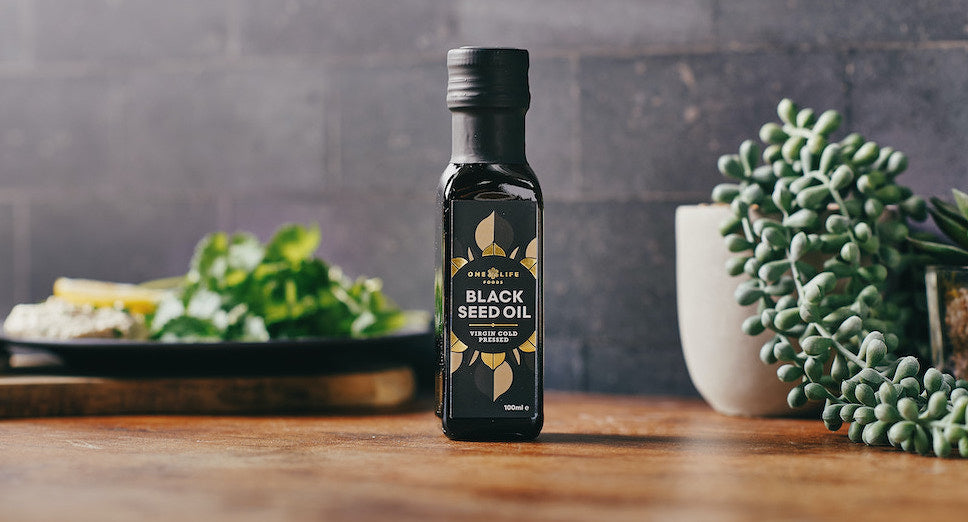
In short: black seed oil is a food supplement valued for its natural profile of plant compounds, the most studied of which is thymoquinone. Quality varies enormously between brands, and the rest of this article explains what the oil contains, what the research does and does not show, and how to judge whether an oil is worth buying.
A short history
The seed has been used for thousands of years across food, traditional medicine, and cosmetics. It has been found in ancient Egyptian sites, and historical accounts associate it with figures such as Tutankhamun and Cleopatra. That long history is part of the appeal, but it is not the reason to take an interest in it today. The more interesting story is what modern analysis has found inside the seed, and why the quality of the oil varies so much from one brand to the next.
What is actually in black seed oil?
The compound most associated with black seed oil is thymoquinone. It is the constituent that has attracted the most scientific attention, and it has been studied for its antioxidant and anti-inflammatory properties in laboratory and preclinical research.
It is important to be clear about what that means. Much of this work has been carried out in cell cultures and animal models, and studies in humans remain more limited. A 2016 review in the Journal of Ethnopharmacology that examined Nigella sativa research published between 1979 and 2015 described antioxidant, anti-inflammatory and other pharmacological properties across in vitro and animal studies, while noting that robust clinical evidence in humans is still developing. A separate 2024 review reached a similar conclusion, summarising the antioxidant effects reported across a wide range of studies while framing the therapeutic potential as an area of ongoing investigation rather than settled fact. In other words, thymoquinone is a genuine and active area of research, not a proven treatment for any condition, and we think that is the honest way to describe it.
Thymoquinone does not work in isolation. Nigella sativa oil contains a wider group of naturally occurring monoterpenes and related compounds, including p-cymene, alpha-pinene, beta-pinene, limonene, alpha-terpinene, gamma-terpinene, thymohydroquinone, carvacrol, and longifolene. These occur together as part of the seed's natural essential oil profile. There is reason to think the whole profile matters rather than any single compound: one 2019 study found that black seed oil's ability to counteract pro-inflammatory markers in human cells did not depend on thymoquinone content alone, but also on the other antioxidant components present in the oil. This is one of the reasons we test for the full range rather than a single headline figure, which we explain further below.
What is black seed oil used for?
In traditional practice, black seed and its oil have been used for a broad range of purposes, from general wellbeing to skin care. People today most often take it as a daily food supplement, and it is also applied topically to the skin.
We want to be careful here, because this is where a lot of black seed oil marketing goes wrong. Black seed oil is a food supplement, not a medicine. It is not a treatment or cure for any disease, and we do not claim that it is. If you are managing a specific health condition, or you are pregnant, breastfeeding, or taking medication, speak to your doctor or pharmacist before adding any new supplement to your routine.
How to tell if a black seed oil is good quality
This is the part that matters most, and it is where most of the useful information sits. There are three things worth checking.
Look at how the thymoquinone figure is calculated. Because thymoquinone is the compound buyers have heard of, some brands quote a percentage that is inflated by combining several related compounds under one number. A figure that lumps thymoquinone together with dithymoquinone, thymohydroquinone, and even thymol will always look higher than the true standalone value. At One Life Foods we list thymoquinone as a standalone quinone. That gives you a true figure rather than a marketing number, even though it is a less flattering one to print on a label. We would rather be accurate than impressive.
Check whether the wider compound profile is tested, not just one number. The value of black seed oil comes from its complete natural profile, so it makes sense to measure the whole profile rather than one part of it. We test for the full group of monoterpenes listed above. To our knowledge we are the only UK brand that carries out this level of analysis.
Look for genuinely independent testing. All of our analysis is verified by an independent laboratory accredited to ILAC MRA standards. ILAC is the international body under which accreditation organisations operate in line with ISO/IEC 17011. In plain terms, the testing is done by a lab whose competence has itself been formally assessed, rather than by us making claims about our own product.
One further point on quality: freshness matters. A 2019 study comparing freshly extracted and stored black seed oil found that the fresh oil contained around a third more thymoquinone, which shows that storage and processing affect the finished oil. Cold pressing without heat, and buying oil that has not sat in storage for long periods, both help preserve the compounds that give the oil its value.
How to take black seed oil
For general use, take one teaspoon daily. It can also be massaged into the skin for topical use.
Two practical notes. First, avoid heating the oil, as heat degrades the delicate volatile compounds that give the oil its value. Second, black seed oil has a strong, peppery, slightly bitter taste that takes some getting used to. Many people prefer to take it with a spoonful of honey, which makes it considerably more pleasant.
Ingredients
100% pure, unfiltered, and unrefined cold pressed oil from Nigella sativa seeds (Egypt). No additives and no preservatives.
The oil is completely unadulterated and in its natural state. Nothing has been added to artificially raise the volatile oil content. As confirmed by third-party lab testing, the naturally occurring compound levels are native to the essential oil of the Nigella sativa seed and consistent with premium quality material.
References
- Gholamnezhad Z, Havakhah S, Boskabady MH. Preclinical and clinical effects of Nigella sativa and its constituent, thymoquinone: A review. Journal of Ethnopharmacology, 2016;190:372–386. https://pubmed.ncbi.nlm.nih.gov/27364039/
- Boskabady MH et al. Comprehensive and updated review on anti-oxidant effects of Nigella sativa and its constituent, thymoquinone, in various disorders. 2024. https://www.ncbi.nlm.nih.gov/pmc/articles/PMC11193497/
- Bordoni L et al. Antioxidant and Anti-Inflammatory Properties of Nigella sativa Oil in Human Pre-Adipocytes. Antioxidants, 2019. https://pubmed.ncbi.nlm.nih.gov/30823525/
Written By
Written by Chris Simon, Founder of One Life Foods.
Chris has worked in the supplement industry since 2009 and is known for seeking out exceptional ingredients, products, and formulations. Read more about Chris and the story behind One Life Foods.


Share:
What Is Shilajit? A Clear Explanation of Composition, Origin, and Use
Shilajit and Ashwagandha: Understanding the Science Behind the Stack