


Quick Answer: Why Is Shilajit Resin Sticky?
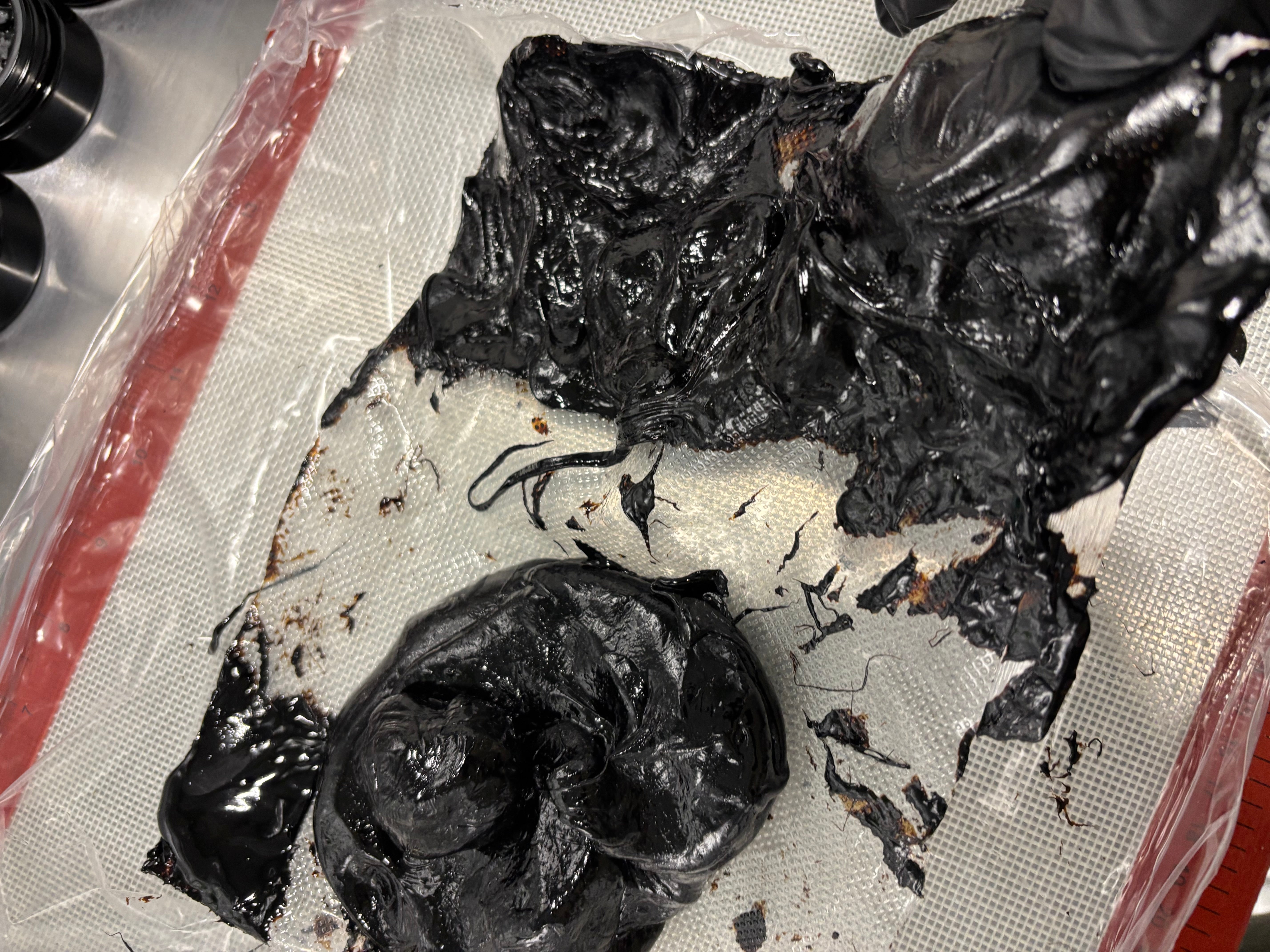
Shilajit resin is sticky because it is a dense humic-mineral matrix, not a simple plant resin. It contains fulvic acid, humic acid, humin, minerals, organic acids, phenolics, salts and bound water. These components create a naturally adhesive, viscoelastic material that can cling, stretch, soften, firm up and behave very differently depending on origin, water content, mineral load, temperature and processing.
Some Shilajit resins are firm and putty-like. Others are softer, glossy, elastic and highly tacky. Both can be legitimate resin textures when the product is cohesive, stable, high-solids and properly tested.
The problem is not natural stickiness.
The problem is when resin becomes wet, loose, syrupy, separated, gritty, unstable or suspiciously easy to spread like dessert sauce.
Real Shilajit is supposed to have some attitude. If it behaves like black honey, we have questions.
Shilajit Is Not Just “Black Resin”
Most people describe Shilajit as a sticky black resin. That is understandable, but chemically it is not quite enough.
True Shilajit is better described as a humic-mineral phytocomplex.
If you are new to the subject, it helps to start with what Shilajit actually is before judging quality by texture alone.
It is formed over long periods from decomposed plant material, microbial transformation and mineral-rich rock environments. What eventually appears as a dark exudate is not one compound, one gum or one active ingredient. It is a complex natural matrix.
That matrix is also why origin, processing and composition matter more than simple marketing labels, as covered in our guide Shilajit explained.
That matrix can contain:
-
Fulvic acid
-
Humic acid
-
Humin
-
Minerals and trace elements
-
Organic acids
-
Phenolic compounds
-
Dibenzo-alpha-pyrones
-
Amino acids and small metabolites
-
Lipid-like and wax-like fractions
-
Bound and semi-bound water
-
Insoluble mineral and organic matter
This is why Shilajit texture varies so much.
A resin can be low in water and still feel extremely tacky.
A resin can contain more water and still feel firmer.
A resin can be soft-set and high-tack without being diluted.
A resin can be very hard without automatically being better.
Texture is not one number. Texture is the behaviour of the whole matrix.
That is the bit most product pages skip, usually somewhere between “ancient mountains” and a suspiciously heroic photograph of a spoon.
The Humic-Mineral Matrix: Why Shilajit Behaves Like Natural Glue
The main structural chemistry of Shilajit comes from humic substances. These are complex dark organic materials formed during the breakdown and transformation of plant and microbial matter.
The three key humic fractions are:
Fulvic acid: smaller, soluble, mobile and rich in polar functional groups.
Humic acid: larger, darker, more structure-forming and less mobile.
Humin: insoluble, heavy, dark and often closely associated with mineral matter.
These are not clean, isolated molecules in the way caffeine or creatine are. They are broad chemical families. That matters.
Fulvic acid helps give Shilajit solubility, mobility and surface activity.
Humic acid helps give body, density and structural behaviour.
Humin and minerals help give backbone, firmness and physical resistance.
A good resin is not simply “high fulvic acid”. That is too basic. Fulvic acid matters, but Shilajit quality is not won by one headline number. The fulvic, humic, humin, mineral and water fractions all contribute to the way the resin behaves.
This is why fulvic acid testing in Shilajit needs proper context rather than blind trust in the biggest percentage on a label.
In resin terms, the question is not just:
“How much fulvic acid is there?”
It is also:
“How is the whole matrix built?”
That is where texture starts to make sense.
The Sticky Chemistry: Why Shilajit Clings, Stretches and Pulls
A naturally glossy, elastic, high-tack resin can be a strong sensory expression of an active humic-fulvic matrix.
Fulvic acid and related low-molecular organic fractions are generally more mobile, more soluble and rich in polar functional groups. These groups interact with water, minerals, skin, glass, stainless steel and packaging surfaces.
That is why real Shilajit can cling, stretch and pull into strands.
This is not a flaw. It is part of the chemistry.
A soft-set, high-tack resin may have more mobile fulvic-rich chemistry at the surface, more bound water acting as a natural plasticiser or a lower structural humic and humin backbone than a firmer resin. That can make it more adhesive, more elastic and much harder to handle during jarring.
None of that means diluted.
The distinction is simple:
Tacky is not the same as wet.
Soft-set is not the same as syrupy.
Elastic is not the same as adulterated.
A good high-tack resin should still be cohesive. It should stretch rather than pour. It should cling rather than run. It should hold shape rather than slump into a loose syrup.
That sticky behaviour, when backed by proper testing, can be part of real resin character.
Messy? Yes.
Chemically interesting? Very.
Why Fulvic-Rich Shilajit Can Feel Tackier
Fulvic acid is generally smaller and more water-soluble than humic acid. It also tends to contain many oxygen-rich functional groups, especially carboxyl and hydroxyl groups.
These functional groups are chemically sociable. They like to interact with things.
They can bind water.
They can interact with minerals.
They can cling to skin.
They can stick to glass.
They can grip stainless steel tools.
They can smear across packaging if given half a chance.
This is one reason a fulvic-forward resin can feel more adhesive. It may have a more mobile, polar, surface-active matrix.
That does not make it poor quality.
It means the resin may have more of its adhesive chemistry available at the surface. If there is enough bound water acting as a natural plasticiser, and less structural humic or humin backbone, the resin can become soft-set, stretchy and very tacky.
This is the type of resin that pulls into strands, clings to gloves and turns jarring into a small endurance event.
Not elegant. Not weak. Just chemically active.
What Humic Acid Does for Texture
Humic acid tends to be darker, larger, more complex and more structure-forming than fulvic acid. It is generally less mobile and contributes more to body and density.
In texture terms, humic acid can contribute to:
-
Firmness
-
Density
-
Cohesion
-
Putty-like behaviour
-
Dark colour
-
Mineral binding
-
Reduced smearing
-
A more structured resin body
A resin with a stronger humic fraction may feel firmer and more controlled. It may still be sticky, because genuine Shilajit resin is naturally sticky, but it is more likely to hold itself together as a dense putty rather than stretch into long adhesive strands.
That does not make it automatically superior to a soft-set, high-tack resin. It simply means the matrix is behaving differently.
One resin may have a strong humic-mineral backbone.
Another may have a more mobile fulvic-rich surface chemistry.
Another may be lower in humic structure but extremely adhesive and elastic.
All three could be genuine. All three could be concentrated. They are simply different expressions of the Shilajit matrix.
Humin and Minerals: The Hidden Skeleton
Humin is the least soluble humic fraction. It is dark, heavy and structural. It does not usually get the same marketing attention as fulvic acid, but it can have a major impact on texture.
Then there is mineral matter.
Mineral content is often exaggerated in Shilajit marketing, especially when brands rely on vague “80+ minerals” claims without showing proper analysis. We cover that in more detail in Does Shilajit contain 84 minerals?
Shilajit comes from geological environments. It is not purely organic. It can contain calcium, magnesium, potassium, iron, silicates, clays, carbonates and other mineral species depending on origin and purification.
These minerals can influence texture in two main ways.
First, they can act as physical structure within the resin. Fine mineral matter can create density, resistance and firmness.
Second, some mineral ions can interact with humic and fulvic acids. Calcium, magnesium, iron and other multivalent ions can bind to carboxylate groups in the humic matrix. These interactions can act a little like tiny bridges, helping the resin hold together more firmly.
This is why a resin with a slightly higher water content can still feel firmer than a drier resin. It may simply have a stronger mineral-humic network.
Hardness is not always dryness.
Firmness is not always superiority.
Texture is chemistry wearing a black coat.
Water Content Matters, But It Is Not the Whole Story
Water content absolutely matters.
Too much water can make Shilajit soft, loose, unstable or diluted. It can also mean the customer gets less actual dry Shilajit solids per gram. Nobody serious wants to pay premium resin prices for mountain cordial.
But water percentage alone does not explain texture.
There are different kinds of water inside a complex resin matrix:
Free water: more mobile and more likely to soften the resin.
Bound water: held by humic substances, minerals and salts.
Plasticising water: water that increases flexibility and tack.
Trapped water: physically held inside the matrix.
A resin can contain 7 or 8 percent water and still feel firm if most of that water is bound inside a strong humic-mineral structure.
Another resin can contain less water and still feel tackier if its water is acting as a plasticiser in a more mobile organic matrix.
That is why judging Shilajit by feel alone can mislead people.
Texture gives clues. Testing gives answers.
Water Content Versus Water Activity
Water content and water activity are not the same thing.
Water content tells you how much water is present.
Water activity tells you how available that water is.
This distinction is important because microbes do not care about total water in isolation. They care about available water.
In Shilajit, water can be bound to humic substances, fulvic acids, minerals and salts. Bound water may appear in testing, but it does not behave like free water.
For serious quality control, water activity is extremely useful.
It is one of the reasons a proper certificate of analysis should be read carefully, rather than treated as a decorative PDF. If you want to understand what those documents actually show, read our guide to how to read a Shilajit lab report.
It helps show whether the product is genuinely wet in a stability sense, or whether it is carrying water inside a dense humic-mineral matrix.
For premium Shilajit resin, the better testing approach is not just “what is the moisture percentage?”
It is:
-
What is the water content?
-
What is the water activity?
-
Is the resin microbiologically clean?
-
Does it hold shape at room temperature?
-
Is the water bound, mobile or free?
-
Does the resin behave like a cohesive resin or a loose paste?
That is a far better standard than just poking a jar and declaring victory.
What Water Content Should Premium Shilajit Resin Have?
For a serious finished Shilajit resin, 20 percent water is not a premium target. That is too high for our preferred standard.
At One Life Foods, we favour a low-moisture, high-solids approach.
A sensible working standard for finished resin would look like this:
| Water content | Interpretation |
|---|---|
| 3 to 6 percent | Very low moisture, dense high-solids resin |
| 6 to 8 percent | Low-moisture resin |
| 8 to 10 percent | Controlled resin, often softer or more mobile |
| 10 to 12 percent | Upper acceptable limit |
| Above 12 percent | Too wet for our preferred standard |
| 15 to 20 percent plus | Water-heavy paste territory |
This does not mean every premium resin must sit at 3 percent water. It means water should be controlled, tested and understood.
A resin at 8 to 10 percent may still be a serious, high-quality resin if it is cohesive, glossy, high-solids, independently tested and stable.
The real dividing line is not soft versus hard. It is concentrated versus diluted. Stable versus unstable. Resinous versus wet.
This is also why price comparisons can be misleading unless you understand what you are actually paying for: resin solids, testing, purification and quality control. We cover that in how much Shilajit should cost.
Firm-Set, Soft-Set, Wet-Set and Over-Set Resin
The easiest mistake is to reduce Shilajit texture to “hard is good, soft is bad”.
That is wrong.
The opposite mistake is also wrong. Soft and tacky is not always better either.
A better texture language is:
Firm-set resin
Soft-set, high-tack resin
Wet-set resin
Over-set resin
This gives a more accurate way to talk about what is happening.
Firm-Set Resin
Firm-set resin is dense, structured and putty-like. It holds shape, resists smearing and often feels easier to portion cleanly. It may be associated with a stronger humic, humin or mineral backbone, lower matrix mobility or lower water content.
Firm-set resin is one legitimate texture expression of real Shilajit.
But it should still behave like resin. It should soften with gentle warmth, become tacky under pressure and dissolve or disperse appropriately in warm water.
If it behaves like a dry stone, that is a different conversation.
Soft-Set, High-Tack Resin
Soft-set resin is glossy, elastic, adhesive and more mobile. It may stretch into strands, cling to tools, smear across surfaces and be difficult to handle during jarring.
This does not mean it is diluted.
Soft-set, high-tack resin can reflect a more mobile humic-fulvic matrix, exposed polar functional groups, bound water acting as a natural plasticiser or a lower humic and humin structural backbone.
This is also one legitimate texture expression of real Shilajit.
A soft-set resin can still be dense, cohesive, high-solids and properly purified. In many cases, its sticky, elastic behaviour may be one of the clearest sensory signs of a mobile fulvic-rich matrix.
Tacky is not the enemy.
Wet is the enemy.
Wet-Set Resin
Wet-set resin is loose, watery, syrup-like or unstable. It may slump, run, look diluted or fail to hold shape at room temperature.
This is not the same as a naturally tacky soft-set resin.
Wet-set behaviour raises questions about excess free water, poor drying, weak concentration or adulteration.
This is where we are happy to be much less polite.
If Shilajit is runny, syrupy, watery, loose, separated or softer than a cohesive soft-set resin, it does not sit in our preferred premium category.
That is not natural variation. That is a quality question.
Over-Set Resin
Over-set resin is excessively hard, brittle, gritty, chalky or awkward to use. It may be over-dried, too mineral-heavy, too insoluble, stored too cold or processed in a way that has reduced its natural plasticity.
A hard resin is not automatically bad. But if it behaves more like a stone than a resin, it deserves investigation.
The best Shilajit resin is not the hardest resin.
Nor is it simply the stickiest resin.
It is the resin with the most honest matrix.
What High-Tack Texture Can Tell Us
High-tack texture can be one of the more interesting behaviours of real Shilajit resin, provided it remains cohesive, glossy and stable.
A tacky resin may have more mobile chemistry at the surface. It may cling more aggressively to tools, gloves and jars. It may stretch, pull into strands and make production handling more difficult. That is inconvenient, but chemically it can make sense.
Shilajit contains polar functional groups, mobile organic acids, minerals, salts and bound water. These components naturally create adhesion. In some resins, especially those with a more mobile humic-fulvic matrix, that adhesive behaviour is more obvious.
The key distinction is whether the resin is still behaving like a resin.
A good high-tack resin should be cohesive. It should stretch rather than pour. It should cling rather than run. It should hold shape rather than slump into a loose syrup.
The concern is not natural tack.
The concern is whether the resin is watery, syrupy, fermenting, mouldy, gritty, separated, artificially softened, unable to hold shape or poorly tested.
Texture gives clues. It should never be treated as the whole verdict.
But Stickiness Can Also Be Faked
Texture matters, but texture alone does not prove authenticity.
The same problem applies to many informal authenticity checks, which is why we do not recommend relying on home tests alone to judge whether Shilajit is genuine.
Some adulterated or imitation Shilajit products can be made sticky using ingredients that have nothing to do with true humic-mineral resin chemistry. Molasses, sugar syrups, caramelised material, gums, thickeners, colourants and low-grade humic extracts can all create a dark, sticky product that looks convincing at first glance.
That is why we do not judge Shilajit by stickiness alone.
Real Shilajit tack comes from a humic-fulvic-mineral matrix. Fake tack can come from syrup.
They may both stick to a spoon. They will not tell the same story in a lab.
The same is true in the other direction. A resin can also be made artificially firm using excessive drying, mineral fillers, clays, charcoal-like material, gums or other binders.
Firm does not automatically mean authentic, just as sticky does not automatically mean high quality.
Texture can be manipulated in both directions.
A product can be faked to look sticky.
A product can be faked to look firm.
A product can be faked to dissolve dark.
A product can be faked to leave mineral residue.
The only serious approach is to combine texture with testing:
-
Fulvic acid
-
Humic acid
-
Humin
-
Water content
-
Water activity
-
Heavy metals
-
Microbiology
-
Total ash
-
Acid-insoluble ash
-
Expanded elemental screening
-
Solubility and dispersibility
-
Sensory checks for odour, texture and residue
These are the kinds of details that separate serious quality control from surface-level claims. For a broader breakdown, see how Shilajit testing actually works.
Texture gives clues. Testing separates real chemistry from theatre.
Can Shilajit Resin Be Too Hard?
Yes.
Hardness can be perfectly natural, but only with context.
A firm resin may suggest low moisture, high solids, a strong humic-mineral structure or a dense resin matrix. Many resins become much firmer in cold conditions, especially in winter. That is normal.
But excessive hardness can also suggest:
-
Very low moisture
-
High mineral or ash content
-
High humin or insoluble matter
-
Over-drying
-
Excessive heat exposure during processing
-
Strong mineral-humic crosslinking
-
High acid-insoluble residue
-
Cold storage conditions
-
Poor customer usability
Some of those are harmless. Some are useful. Some need investigation.
A good firm-set resin should still soften with warmth. It should not remain gritty, chalky or inert. It should not be so brittle that normal use becomes a chore.
Shilajit should be dense. It should not behave like a lump of tarmac that has given up on civilisation.
Insoluble Minerals, Ash and the Hidden Side of Hardness
One of the most overlooked parts of Shilajit texture is insoluble mineral load.
A resin can feel very firm because it contains more structural mineral matter. That does not automatically mean it is dangerous, but it does mean the texture is not simply about water.
Insoluble mineral load may include:
-
Silicates
-
Clays
-
Aluminosilicates
-
Iron oxides
-
Calcium salts
-
Magnesium salts
-
Carbonates
-
Quartz-like mineral residue
-
Earthy rock-derived material
-
Metal-bearing mineral complexes
Some of these can increase firmness, density or brittleness. Some can contribute to grit or poor dispersibility if not well purified. Some may not show up clearly on a basic heavy metal COA.
This is where many standard certificates of analysis can be limited.
A typical heavy metal panel often focuses on lead, cadmium, arsenic and mercury. Those are essential tests. But they are not a full elemental fingerprint.
They do not necessarily tell you:
-
Total ash
-
Acid-insoluble ash
-
Aluminium content
-
Iron level
-
Nickel
-
Chromium
-
Tin
-
Vanadium
-
Strontium
-
Barium
-
Uranium
-
Total mineral structure
-
Whether hardness is coming from humic structure or mineral residue
That does not mean every hard resin is unsafe. It means a serious brand should understand what is causing the hardness.
For Shilajit, useful extra tests include:
-
Total ash
-
Acid-insoluble ash
-
Expanded ICP-MS elemental screening
-
Humic, fulvic and humin split
-
Insoluble matter
-
pH
-
Solubility and dispersibility
-
Water content
-
Water activity
The standard four heavy metals are important. They are not the full story.
Contaminant testing becomes especially important with natural resin products because the risk is not always visible. We explain this further in PAHs, solvents and microbial testing in Shilajit.
What About Crystallisation Around the Jar?
Some Shilajit resin can form crusty, shiny or crystalline-looking deposits around the rim of the jar after opening. This is not automatically a problem.
The rim is exposed to air every time the jar is opened. Thin smears of resin dry much faster than the bulk resin inside the jar. As water evaporates, dissolved minerals, salts and organic fractions can concentrate at the surface. These may leave a dry, crystalline or glassy-looking residue.
This can be caused by:
-
Evaporation from thin resin films
-
Mineral salt migration
-
Fulvic and humic salts drying at the surface
-
Temperature changes
-
Humidity cycling after opening
-
Repeated contact with spoons or fingers
Minor rim crystallisation can therefore be a normal behaviour of a mineral-rich natural resin.
However, crystallisation still needs context.
If the crystals look sugary, gritty, widespread or are paired with a sweet smell, syrupy texture or unusual stickiness, then adulteration with sugar syrup, molasses or other sweet sticky materials should be considered.
The rule is simple:
A little rim crystallisation can be normal. Heavy sugar-like crystallisation is a red flag.
Again, texture starts the conversation. Testing finishes it.
Why Shilajit Becomes Harder in the Cold
Shilajit does not behave like a purified compound with a neat melting point. It softens across a range because the matrix is held together by many weak and reversible interactions.
These include:
-
Hydrogen bonding
-
Hydrophobic interactions
-
Ionic interactions
-
Mineral bridging
-
Van der Waals forces
-
Aromatic stacking
-
Water-mediated structuring
When the temperature drops, molecular movement slows. The resin becomes firmer and can become hard or brittle.
When the temperature rises, the matrix becomes more mobile. The resin softens, stretches and becomes tackier.
This is why a jar can be very firm in winter and much more workable after gentle warming. That is normal for a low-moisture natural resin.
It is not a defect. It is thermodynamics being mildly dramatic.
Why Shilajit Is So Hard to Jar
If you have ever jarred real Shilajit resin by hand, you will know it has the operational manners of roofing tar.
The handling problem comes from two forces working together:
Cohesion: the resin sticks to itself.
Adhesion: the resin sticks to everything else.
When both are high, the resin stretches, strings, pulls, smears, clings and coats anything within reach. Especially gloves. Especially tools. Especially the exact part of the jar you were trying to keep clean.
High-tack resin can be caused by:
-
A more mobile fulvic fraction
-
Lower humic or humin structure
-
More exposed polar surface chemistry
-
Bound water acting as a plasticiser
-
Hygroscopic salts
-
Warm filling conditions
-
High humidity
-
Recent processing before full batch equilibration
The answer is not always to warm it more. Heat can make resin flow, but it can also make it stringier and more adhesive.
For very tacky resin, cooler and drier handling may help.
Practical production controls include:
-
Cooler filling conditions if workable
-
Low humidity
-
Stainless steel tools
-
Short rigid spatulas
-
Wide-mouth jars
-
Pre-weighed portions
-
Minimal repeated handling
-
Allowing the batch to equilibrate before filling
-
Avoiding excessive warmth unless using proper depositing equipment
Warm resin can look like the answer. Then it becomes a black elastic problem with commitment issues.
Is Sticky Shilajit a Sign of Quality?
It can be.
Sticky Shilajit can be a sign of a genuine resin matrix with active humic and fulvic chemistry. It should have density, gloss, cohesion and natural tack.
However, wetness, runniness or syrup-like behaviour can suggest poor concentration, too much free water or adulteration.
So the better answer is:
Stickiness is natural. Wetness is not.
A good resin should usually be:
-
Glossy
-
Dense
-
Cohesive
-
Naturally tacky
-
Able to hold shape
-
Responsive to temperature
-
Softening with warmth
-
Firming in the cold
A resin can be firm-set or soft-set. Both can be high quality.
The warning signs are:
-
Watery texture
-
Loose syrup-like flow
-
Sour or fermented smell
-
Mould
-
Gritty residue
-
Poor solubility beyond what is expected
-
Lack of testing
-
Excessively high moisture
-
Excessive insoluble matter
-
Basic COAs with little real detail
Quality is not a spoon test. Quality is chemistry plus testing.
That is also why buying Shilajit should never come down to texture, colour or origin claims alone. Our practical guide explains what to look for when buying Shilajit.
Does Hard Shilajit Mean Better Shilajit?
No.
Hardness alone does not prove quality.
A resin can be hard because it is low in water.
It can be hard because it is cold.
It can be hard because it is high in humic structure.
It can be hard because it contains more mineral matter.
It can be hard because it has more insoluble ash.
It can be hard because it has been over-dried.
Only some of those are clearly positive.
Likewise, a softer resin is not automatically poor. It may have a more mobile humic-fulvic matrix, more exposed polar chemistry or a different origin profile.
The serious markers are:
-
Independent testing
-
Controlled water content
-
Water activity
-
Heavy metals
-
Expanded elemental screening where needed
-
Microbiology
-
Fulvic acid
-
Humic acid
-
Humin
-
Ash
-
Acid-insoluble ash
-
Solubility and dispersibility
-
Batch traceability
Texture is useful. It is not the verdict.
The Fulvic-to-Humic Ratio and Why It Matters
One useful way to understand Shilajit texture is the relationship between fulvic acid and humic acid.
A resin with more humic structure may feel firmer, denser and more putty-like.
A resin with a more fulvic-dominant or lower-humic matrix may feel more mobile, adhesive and tacky.
But this is not a fixed rule. Natural materials enjoy making neat rules look foolish.
A high-fulvic resin can still be firm if it has enough humic, humin or mineral backbone.
A lower-moisture resin can still be tacky if its matrix is mobile and adhesive.
A higher-water resin can feel firm if the water is bound within a strong humic-mineral structure.
The full behaviour comes from the whole system.
That is why serious Shilajit cannot be judged by fulvic percentage alone.
What Should Premium Shilajit Resin Feel Like?
At normal room temperature, premium resin should usually feel:
-
Dark brown to black
-
Glossy
-
Dense
-
Cohesive
-
Naturally sticky
-
Firm-set or soft-set
-
Responsive to warmth
-
Able to hold shape
-
Capable of dissolving or dispersing in warm water, depending on purification and composition
It should not be:
-
Watery
-
Syrupy
-
Foamy
-
Mouldy
-
Sour-smelling
-
Artificially perfumed
-
Obviously gritty
-
Chalky
-
Weak, loose or unstable
-
Suspiciously easy to spread like dessert sauce
Some inconvenience is normal. Real Shilajit resin is not designed by a user experience team.
How We Think About Shilajit Texture at One Life Foods
At One Life Foods, we do not believe the hardest resin automatically wins.
We also do not dismiss a soft-set, high-tack resin. When that tackiness is cohesive, glossy, elastic and backed by testing, it can be one of the more interesting expressions of Shilajit chemistry.
Our view is simple:
Firm-set resin can show density and structure.
Soft-set, high-tack resin can show mobility and active humic-fulvic behaviour.
Wet-set resin is where concern begins.
Over-set resin may need investigation.
The goal is not maximum hardness.
The goal is a high-solids, cohesive, tested, stable resin with a clearly understood chemical profile.
If you want to compare different regional resin profiles, you can explore our Shilajit resin collection.
That means looking at the full picture:
-
Water content
-
Water activity
-
Fulvic acid
-
Humic acid
-
Humin
-
Ash
-
Acid-insoluble ash
-
Heavy metals
-
Expanded elemental profile
-
Microbiology
-
pH
-
Solubility
-
Origin
-
Processing
-
Texture at room temperature
That is how you judge Shilajit properly.
Not by whether it ruins your spoon. Although it probably will.
Final Answer: Shilajit Stickiness Is Chemistry, Not Mystery
Shilajit resin is sticky because it is a concentrated humic-mineral matrix filled with polar functional groups, mobile fulvic fractions, larger humic structures, insoluble humin, minerals, salts and bound water.
Fulvic acid contributes mobility, solubility and surface adhesion.
Humic acid contributes body, density and structure.
Humin and minerals contribute backbone and firmness.
Water can soften the resin, but only depending on whether it is free, bound or acting as a plasticiser.
This is why one resin can be low in water and still feel tacky. Another can contain more water and feel firmer. Another can be soft-set, glossy and high-tack without being diluted.
The best Shilajit resin is not always the hardest resin.
Nor is it simply the stickiest resin.
It is the resin with the most honest matrix.
Real Shilajit is naturally sticky. When it is purified, tested, stable and high-solids, that stickiness is not a flaw.
It is the chemistry showing itself.
Share:
Stimulants Don’t Hydrate You: Why Caffeine, Sweat Loss and Electrolytes Need Different Strategies