


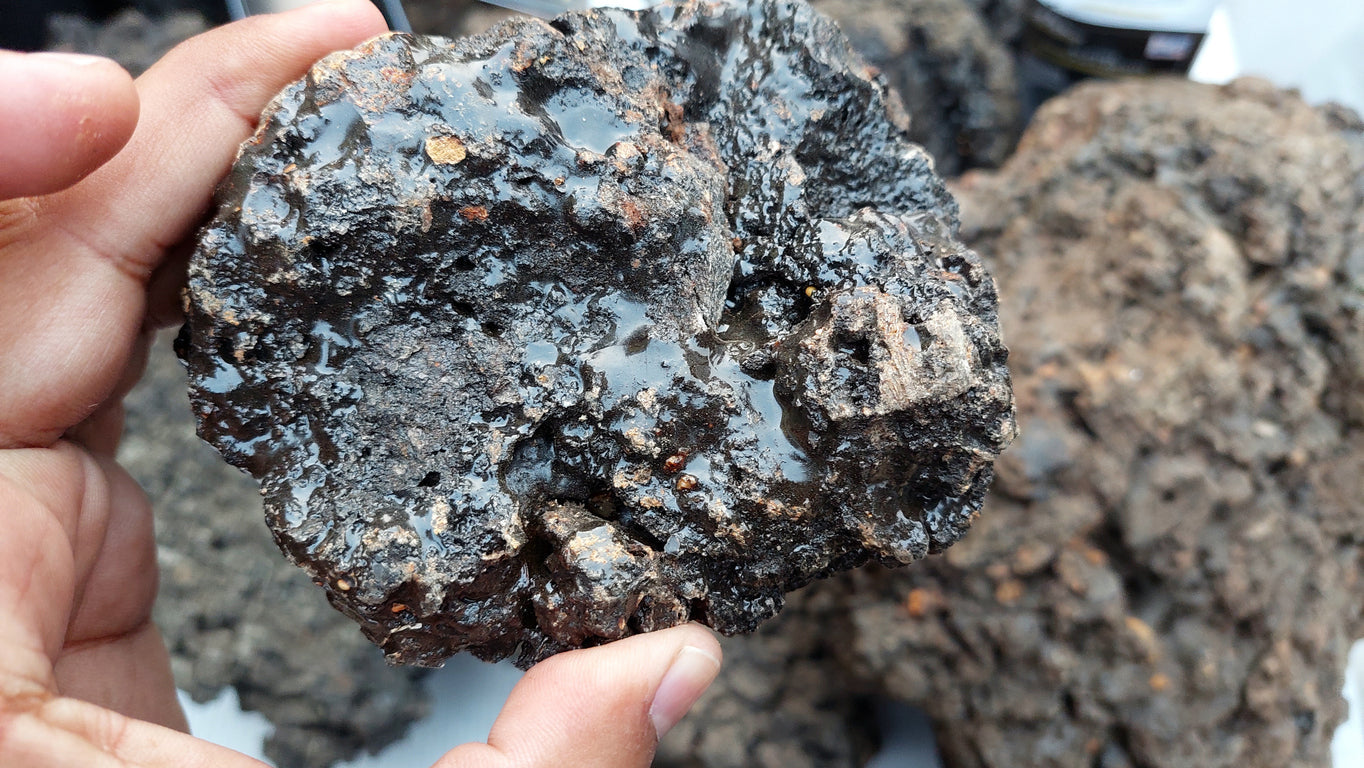
Shilajit is regularly described as containing vitamins, minerals, amino acids, fulvic acid and almost every other category of nutrient that sounds good on a product page.
The minerals are at least measurable.
The vitamin claim is much less secure.
Some websites state that Shilajit naturally contains B vitamins. Others list vitamin C, vitamin E or vitamin D. A few describe it as a kind of natural multivitamin, and without showing:
-
Which vitamin forms were identified
-
How they were tested
-
How much was present
-
Whether the result came from raw Shilajit or purified resin
-
How much would be delivered by a normal serving
-
Whether the compound remained stable throughout the product’s shelf life
Those aren’t minor omissions.
Detecting a vitamin isn’t the same as establishing a useful nutritional source. Repeating a list copied from another website isn’t chemical analysis.
The current scientific position is more restrained:
Shilajit is known to contain a complex mixture of humic substances, mineral elements and smaller organic compounds. It hasn’t been shown to possess a consistent, nutritionally meaningful natural vitamin profile.
That doesn’t prove that no vitamin-related molecule could ever be found in any Shilajit sample.
Shilajit varies according to region, local plant material, microbial activity, environmental conditions, purification and processing. Trace vitamin compounds or related metabolites may theoretically occur in individual samples.
But possibility isn’t proof.
To describe Shilajit as a useful source of vitamins, we would need vitamin-specific identification, reliable quantification and evidence that an ordinary serving supplies a meaningful amount.
That evidence is currently missing.
Quick answer: Does Shilajit contain vitamins?
There’s no established evidence that ordinary Shilajit resin supplies meaningful amounts of recognised vitamins.
Scientific analyses identify humic and fulvic substances, mineral elements, organic acids, phenolic compounds and other plant-derived or microbial-derived molecules. Shilajit hasn’t been shown to contain a consistent natural profile of vitamins B1, B2, B3, B6, B12, C, D, E, K or other recognised vitamins at nutritionally significant levels.
A trace vitamin-related compound may theoretically be present in an individual sample.
That’s very different from claiming that Shilajit is a useful vitamin source.
What is Shilajit actually known to contain?
Shilajit isn’t one molecule and it isn’t simply liquid rock.
It’s a complex organic-mineral material associated with transformed plant matter, microbial activity and the surrounding geological environment.
Depending on the source and analytical method, researchers have reported:
-
Fulvic fractions
-
Humic fractions
-
Dibenzo-alpha-pyrones and related compounds
-
Phenolic acids
-
Fatty acids
-
Other organic acids
-
Mineral elements
-
Inorganic anions
-
Numerous smaller organic constituents
A 2026 study used HPLC-MS/MS to identify and quantify nine phenolic acids across 11 raw Shilajit samples with supplier-declared origins from Iran, India, Nepal, Russia and Kyrgyzstan. These included gallic, vanillic, syringic, caffeic, p-coumaric, ferulic, sinapic, chlorogenic and rosmarinic acids.
The study found substantial variation between samples, although the material wasn’t collected through a georeferenced field campaign and the number of samples from each region was small.
Other studies have measured elements such as calcium, magnesium, potassium, iron, zinc and manganese, along with inorganic ions including chloride, sulphate, nitrate, phosphate and fluoride.
These results show that Shilajit is chemically interesting.
They don’t make it a multivitamin.
For a broader explanation of its composition, read What Is Shilajit?.
What counts as a vitamin?
A vitamin isn’t simply any organic molecule found in nature.
Vitamins are recognised organic micronutrients needed for normal physiological function that the human body can’t synthesise in sufficient quantities.
The accepted groups include:
-
Vitamin A
-
The B-vitamin group
-
Vitamin C
-
Vitamin D
-
Vitamin E
-
Vitamin K
Each group may contain several chemically related forms known as vitamers.
For example:
-
Vitamin A includes retinol and related retinoids
-
Vitamin B3 includes nicotinic acid and nicotinamide
-
Vitamin B6 includes pyridoxine, pyridoxal and pyridoxamine forms
-
Vitamin B12 includes biologically relevant cobalamins
-
Vitamin D includes vitamin D2 and vitamin D3
-
Vitamin E includes tocopherols and tocotrienols
-
Vitamin K includes phylloquinone and menaquinones
This matters because a serious vitamin claim should identify what was actually measured.
Saying that Shilajit contains “vitamin B” is chemically vague.
Saying it contains “vitamin D” without distinguishing D2 from D3 is incomplete.
Saying it contains “B12” without identifying the cobalamin form or considering inactive corrinoid analogues may also be misleading.
What doesn’t count as a vitamin?
Many recognised Shilajit constituents are organic and potentially biologically active.
That doesn’t make them vitamins.
The following aren’t vitamins:
-
Fulvic acid
-
Humic acid
-
Dibenzo-alpha-pyrones
-
Phenolic acids
-
Amino acids
-
Fatty acids
-
Other organic acids
-
Mineral elements
-
Electrolytes
-
Plant pigments
-
Microbial metabolites in general
“Organic compound” is a chemical category.
“Vitamin” is a nutritional classification.
The two aren’t interchangeable.
A molecule can be biologically active without being a vitamin. Caffeine, creatine, taurine and thousands of plant polyphenols are obvious examples.
Shilajit doesn’t become vitamin-rich simply because it contains many different carbon-based compounds.
What is established about Shilajit composition?
Several broad statements are defensible.
Shilajit contains organic compounds
True.
Humic substances and smaller organic constituents form a substantial part of its chemical identity.
Shilajit contains minerals and trace elements
True, although the number and concentration vary considerably.
Elemental analyses may detect calcium, magnesium, potassium, sodium, iron, zinc, manganese and many other elements. They can also detect undesirable elements, which is why a long list isn’t automatically evidence of nutritional quality.
Shilajit contains plant-derived and microbial-derived compounds
True.
Its composition reflects transformed organic inputs and biological activity rather than a single purified botanical ingredient.
Its composition varies between samples
True.
Geography, geology, plant material, environmental conditions, processing and the analytical method can all affect the result.
Shilajit may contain compounds that haven’t been fully characterised
True.
Modern reviews continue to describe considerable uncertainty surrounding its complete chemical composition.
None of these points establishes meaningful vitamin content.
Why do some brands claim Shilajit contains vitamins?
There are several likely explanations.
1. One unsupported list is copied by another website
Supplement marketing often develops through repetition.
A website publishes an unsourced claim that Shilajit contains several vitamins. Other writers repeat it. Search engines then discover multiple pages making the same statement, creating the appearance of independent confirmation.
Five websites repeating one unsupported list still amount to one unsupported list.
Frequency isn’t validation.
2. Vitamins and minerals are grouped together
The phrase “vitamins and minerals” is familiar to consumers, so the two categories are often joined automatically.
But an elemental test can’t establish intact vitamins.
Methods such as:
-
ICP-MS
-
ICP-OES
-
Atomic absorption spectroscopy
-
X-ray fluorescence
-
Laser-induced breakdown spectroscopy
measure elements.
They may show that a sample contains magnesium, calcium, iron, cobalt or zinc.
An ordinary elemental report can’t identify intact molecules such as vitamin C, vitamin D or a specific form of vitamin B12. Vitamin testing requires appropriate molecular extraction, separation and confirmation methods.
A mineral report isn’t a vitamin report.
3. Organic compounds are mistaken for vitamins
Shilajit contains many organic constituents.
Some descriptions appear to move from:
Shilajit contains organic compounds
to:
Shilajit contains organic nutrients
and finally to:
Shilajit contains vitamins.
That progression may sound plausible in ordinary language, but it doesn’t follow chemically.
Vitamins are specific molecules or related families of molecules.
A broad organic profile can’t be converted into a vitamin list.
4. Plant origin is treated as proof
Shilajit is thought to contain transformed plant-derived material.
Plants contain vitamins.
Therefore, the argument goes, Shilajit must contain vitamins.
The missing part of that argument is a prolonged period of environmental transformation, microbial metabolism, oxidation, water movement and chemical degradation.
The original plant material would also have contained:
-
Proteins
-
Pigments
-
Sugars
-
Cell membranes
-
Enzymes
-
Nucleic acids
-
Unstable metabolites
Nobody assumes that all of these remain intact in the finished resin.
Plant origin doesn’t prove preservation of the plant’s original vitamin content.
5. Added vitamins are attributed to the Shilajit
Many Shilajit products are multi-ingredient formulations.
Gummies and capsules may contain separately added:
-
Vitamin B6
-
Vitamin B12
-
Vitamin C
-
Vitamin D
-
Folic acid
-
Zinc
-
Other micronutrients
The finished product may therefore contain vitamins.
That doesn’t mean its Shilajit naturally supplied them.
The distinction should be simple:
A Shilajit supplement can contain added vitamins without Shilajit itself being a natural source of those vitamins.
Check the ingredient list rather than assuming that everything in the nutrition panel came from the resin.
6. Detection is confused with nutritional relevance
A laboratory may detect an extremely small quantity of a compound.
That result may be analytically interesting.
It may still contribute virtually nothing at the recommended serving size.
This is especially important for Shilajit because a serving is usually measured in hundreds of milligrams rather than tens or hundreds of grams.
Detection isn’t the same as dose
Consider a hypothetical example.
Imagine that a laboratory identified 1 milligram of a vitamin in every kilogram of Shilajit.
One kilogram contains 1,000 grams.
A 500 milligram serving is 0.5 grams.
At a concentration of 1 milligram per kilogram, a 500 milligram serving would provide:
-
0.0005 milligrams
-
Or 0.5 micrograms
Whether that matters depends on the vitamin.
For vitamin C, whose UK nutrient reference value is 80 milligrams, 0.5 micrograms would be nutritionally negligible.
For vitamin B12, whose nutrient reference value is 2.5 micrograms, 0.5 micrograms would be more relevant. But only if the substance were confirmed as a biologically relevant form of B12, consistently present and stable at that concentration.
The correct questions are therefore:
-
What exact molecule was found?
-
At what concentration?
-
In what chemical form?
-
Was it found in raw material or finished resin?
-
Which analytical method was used?
-
How much is delivered per serving?
-
How much remains at the end of shelf life?
-
Is the result reproducible across batches?
Without those answers, “contains vitamins” conveys very little.
What would count as a meaningful vitamin source?
In the UK, nutrition claims such as “source of vitamin C” or any wording likely to carry the same meaning can only be used when the product meets the relevant conditions.
That requires more than analytical detection.
The product must supply the applicable significant amount of the named nutrient under current UK nutrition-claim and food-information rules. For a food supplement, the amount supplied by the recommended daily portion and its percentage of the relevant nutrient reference value are central to that assessment.
The exact legal interpretation depends on the product, labelling and presentation. Brands should obtain current compliance advice before making vitamin or mineral claims.
The wider scientific principle is simpler:
A meaningful nutrient claim should correspond to a useful serving-level amount, not merely the existence of a trace.
A responsible company should identify and quantify the vitamin per recommended daily serving rather than hiding a small concentration behind per-kilogram units.
Does Shilajit contain B vitamins?
There’s no well-established evidence that natural Shilajit resin provides a meaningful and consistent spectrum of B vitamins.
The B-vitamin family includes chemically distinct nutrients:
| Vitamin | Name | Current conclusion for Shilajit |
|---|---|---|
| B1 | Thiamin | No consistent, meaningful thiamin content has been established |
| B2 | Riboflavin | No useful serving-level amount has been established |
| B3 | Niacin | General organic acids don’t prove nicotinic acid or nicotinamide |
| B5 | Pantothenic acid | Theoretical occurrence doesn’t establish survival or nutritional dose |
| B6 | Pyridoxine-related vitamers | Added B6 in a supplement shouldn’t be attributed to its Shilajit |
| B7 | Biotin | No consistent serving-level content has been established |
| B9 | Folates | No reliable profile of individual folate forms has been established |
| B12 | Cobalamins | No meaningful natural B12 content has been established |
There’s no single “B-vitamin test” that proves the presence of all these nutrients.
Each presents its own analytical challenges involving:
-
Extraction
-
Chemical form
-
Stability
-
Matrix interference
-
Detection limits
-
Biological activity
A Shilajit sample shouldn’t be described as containing a “B-complex” unless the individual vitamins have been identified and quantified. We've never seen a lab report anywhere to show this.
Does Shilajit contain vitamin B12?
Vitamin B12 is probably the most important individual myth to address.
There’s no established evidence that ordinary Shilajit resin is a meaningful natural source of active vitamin B12.
Certain bacteria and archaea can synthesise cobalamins. The fact that microbial activity is involved in Shilajit formation makes trace cobalamin-related compounds theoretically possible.
But that’s only the beginning of the question.
B12 is chemically complicated
“Vitamin B12” may refer broadly to a group of cobalt-containing cobalamin compounds.
Not every corrinoid detected by a non-specific assay necessarily has useful vitamin B12 activity in humans. Some microorganisms produce B12-like analogues that may respond in certain microbiological or immunological tests without functioning as an active human vitamin.
A serious analysis should identify the relevant form, such as:
-
Methylcobalamin
-
Adenosylcobalamin
-
Hydroxocobalamin
-
Cyanocobalamin
Methylcobalamin and adenosylcobalamin are metabolically active forms. Hydroxocobalamin and cyanocobalamin can be converted into active forms within the body.
A vague B12-like laboratory signal isn’t enough.
Microbial origin doesn’t prove surviving B12
Even if microorganisms involved in the formation of a particular deposit produced cobalamins, the finished material has undergone:
-
Environmental exposure
-
Chemical transformation
-
Oxidation
-
Water movement
-
Extraction
-
Purification
-
Concentration
-
Storage
The relevant cobalamin would need to survive this history and remain present at a useful concentration.
What would prove B12 in Shilajit?
At minimum:
-
Selective extraction from the humic matrix
-
Chromatographic separation
-
Specific molecular confirmation
-
Quantification of relevant cobalamins
-
Consideration of inactive analogues
-
Results per gram and per serving
-
Repeat testing across batches
-
Stability testing over shelf life
Until then, “Shilajit contains B12” should be treated as unverified.
Does Shilajit contain vitamin C?
There’s no established evidence that ordinary Shilajit resin supplies a meaningful amount of vitamin C.
Vitamin C, or ascorbic acid, is a comparatively reactive water-soluble molecule. It can degrade through oxidation, particularly when exposed to:
-
Oxygen
-
Heat
-
Moisture
-
Light
-
Transition metals
-
Prolonged storage
Shilajit is associated with long-term environmental transformation of organic material. It is then commonly purified through dissolution, filtration and reconcentration.
It isn’t impossible that trace ascorbate-related material could be detected in an individual sample.
It’s difficult to justify a meaningful vitamin C claim without direct testing of the finished resin.
Fresh plants may contain vitamin C.
Shilajit isn’t fresh plant material.
Possible origin and present composition are different questions.
Does Shilajit contain vitamin D?
There’s no established evidence that natural Shilajit resin is a meaningful source of vitamin D.
A proper claim would first need to specify:
-
Vitamin D2, or ergocalciferol
-
Vitamin D3, or cholecalciferol
-
Another vitamin D-related metabolite
Vitamin D2 can arise from fungal sterols after ultraviolet exposure, while vitamin D3 is strongly associated with animal-derived and certain lichen-derived sources.
Shilajit has a complicated biological and environmental history, so traces of sterols or related metabolites can’t be ruled out in every possible sample.
But no reproducible natural vitamin D content has been established.
A Shilajit gummy containing added cholecalciferol is a vitamin-D-fortified product.
It isn’t proof that Shilajit resin naturally contains D3.
What about vitamins A, E and K?
There’s no established evidence that normal Shilajit servings provide meaningful amounts of vitamins A, E or K.
Vitamin A
Vitamin A includes retinoids such as retinol and retinal, while plant foods may provide provitamin-A carotenoids such as beta-carotene.
Shilajit’s dark colour doesn’t indicate retinoids or carotenoids. Long environmental transformation would also make the survival of intact pigments uncertain.
Vitamin E
Vitamin E refers to tocopherols and tocotrienols.
Shilajit may contain fatty acids and lipid-like organic constituents, but that doesn’t prove the presence of meaningful vitamin E. A valid claim would require identification and quantification of specific tocopherol or tocotrienol forms.
Vitamin K
Vitamin K includes phylloquinone and multiple menaquinones.
Some menaquinones can be produced by microorganisms, creating a theoretical pathway by which vitamin-K-related compounds might occur in biologically transformed material.
Again, theoretical formation isn’t evidence of consistent survival or useful concentration.
Does Shilajit contain minerals rather than vitamins?
This is where the stronger analytical evidence lies.
Studies repeatedly identify mineral elements in Shilajit, although results differ considerably between samples.
But even “contains minerals” needs qualification.
Elemental analysis may identify:
-
Nutritionally essential minerals
-
Elements with no established nutritional role
-
Potentially harmful elements
-
Geological contaminants
A long periodic-table list doesn’t tell us:
-
Chemical form
-
Solubility
-
Bioavailability
-
Amount per serving
-
Whether the concentration is beneficial or undesirable
The correct follow-on question is explored in Does Shilajit Really Contain 85 Minerals?.
Minerals are also not vitamins.
Calcium, magnesium, zinc, iron and selenium are chemical elements with nutritional roles at appropriate intakes. Evidence for mineral content can’t be used as proof of vitamin content.
Does Shilajit contain amino acids?
Some compositional literature has reported amino acids or other nitrogen-containing compounds in Shilajit.
Even if amino acids are detected, that doesn’t make Shilajit a meaningful protein source.
A normal resin serving is very small. A trace amino-acid profile can’t be compared with the grams of essential amino acids obtained from food or a protein supplement.
The same principle applies:
Chemical presence mustn’t be confused with nutritional dose.
Is Shilajit a natural multivitamin?
No credible evidence supports describing ordinary Shilajit resin as a natural multivitamin.
A multivitamin is formulated to provide declared amounts of recognised vitamins per daily serving.
Shilajit is naturally variable and has no established standard vitamin specification.
It can’t reliably be used to supply:
-
Vitamin C
-
Vitamin D
-
Vitamin B12
-
Folate
-
A complete B-vitamin spectrum
-
Any other predictable range of essential vitamins
A formulation combining Shilajit with added vitamins may function as a multi-ingredient vitamin supplement.
The Shilajit ingredient shouldn’t receive credit for nutrients added separately.
Can Shilajit replace a multivitamin?
No.
There’s no evidence that Shilajit provides a complete or predictable range of essential vitamins.
Someone using Shilajit instead of addressing a genuine vitamin deficiency could remain deficient.
This is particularly important for nutrients such as:
-
Vitamin B12
-
Vitamin D
-
Folate
-
Vitamin C
Shilajit shouldn’t be presented as a substitute for a varied diet, an appropriately formulated supplement or treatment recommended by a qualified healthcare professional.
Does fulvic acid contain vitamins?
Fulvic acid isn’t a vitamin.
Nor should it be treated as a container that automatically proves the presence of vitamins.
Fulvic fractions contain complex mixtures of relatively low-molecular-weight, acid-soluble organic substances. Their composition depends on the source and the analytical definition used.
Fulvic material may interact with minerals and organic compounds.
It isn’t itself a B-complex, a form of vitamin C or a multivitamin system.
Could Shilajit improve vitamin absorption?
This is a separate question from whether Shilajit contains vitamins.
Fulvic substances can interact with minerals and organic compounds, and those interactions may sometimes alter solubility, stability or bioaccessibility.
That doesn’t prove that Shilajit broadly improves vitamin absorption in humans.
Any absorption claim should identify:
-
The specific vitamin
-
The Shilajit preparation
-
The dose
-
The formulation
-
The study design
-
The measured pharmacokinetic outcome
A product could theoretically influence the handling of a nutrient without naturally containing that nutrient.
Conversely, saying that Shilajit contains fulvic substances doesn’t prove that it enhances the absorption of vitamin B12, vitamin D or every other substance taken with it.
For a deeper explanation, read What Does the Body Actually Absorb From Shilajit?.
Could trace vitamins exist in some Shilajit?
Yes. This remains scientifically possible.
Shilajit is a naturally variable material formed through complicated biological and geological processes.
Potential routes could include:
-
Residual plant-derived compounds
-
Microbial synthesis
-
Microbial metabolites
-
Environmental contamination
-
Compounds introduced during processing
It would therefore be too absolute to state:
No Shilajit sample anywhere can contain any vitamin molecule.
Science rarely rewards claims of absolute absence in heterogeneous natural materials.
The more accurate conclusion is:
Vitamins haven’t been established as consistent, characteristic or nutritionally meaningful constituents of Shilajit resin.
That leaves room for future evidence without allowing unsupported marketing claims to pass as established composition.
Absence of evidence isn’t always evidence of absence
A study using ICP-MS can’t tell us whether vitamin C is present because the method measures elements rather than intact vitamin molecules.
A GC-MS method may identify volatile or derivatised organic compounds while missing unstable, non-volatile or poorly extracted vitamins.
A broad untargeted analysis may fail to detect a compound present below its detection threshold.
The fact that a study doesn’t list a vitamin doesn’t always prove complete absence.
But this cuts both ways.
A brand can’t use the possibility of an undetected vitamin as evidence that the vitamin is present.
The burden of evidence belongs to the person making the claim.
Fortunately, we don’t need to prove that every Shilajit deposit on Earth contains exactly zero molecules of every vitamin.
To reject Shilajit as a useful vitamin source, we only need to observe that consistent and meaningful serving-level amounts haven’t been demonstrated.
Why vitamin testing in Shilajit is difficult
Shilajit is an analytically challenging material.
Its dark humic matrix may:
-
Bind target compounds
-
Interfere with colour-based assays
-
Suppress or enhance mass-spectrometry signals
-
Complicate extraction
-
Produce overlapping chromatographic peaks
-
Affect microbiological or immunological assays
A laboratory should therefore show that its method works within Shilajit specifically.
A procedure validated for fruit juice, flour or a simple tablet may not achieve the same recovery from resin.
Matrix recovery matters
A useful validation experiment would add a known amount of a vitamin to the Shilajit sample and then measure how much is recovered.
Poor recovery could produce a false negative.
Matrix interference could create an exaggerated result or false positive.
Identification matters
A peak appearing at roughly the correct retention time isn’t always enough.
Confirmation may require:
-
Authentic reference standards
-
Spectral matching
-
Multiple reaction monitoring
-
Accurate mass measurements
-
A second analytical method
Stability matters
Some vitamins degrade during sample preparation.
The laboratory may need to control:
-
Light
-
Oxygen
-
pH
-
Temperature
-
Antioxidants
-
Processing time
A casual “vitamin panel” may be less definitive than it sounds.
How should Shilajit be tested for vitamins?
A serious investigation would test authenticated, purified resins from several origins and batches.
Step 1: Define the target vitamins
Rather than requesting a generic “vitamin test”, specify the individual targets:
-
Thiamin and relevant phosphorylated forms
-
Riboflavin
-
Nicotinic acid and nicotinamide
-
Pantothenic acid
-
Individual B6 vitamers
-
Biotin
-
Folate forms
-
Individual cobalamins
-
Ascorbic and dehydroascorbic acid
-
Retinoids and carotenoids
-
Vitamin D2 and D3
-
Tocopherols and tocotrienols
-
Phylloquinone and relevant menaquinones
Step 2: Use vitamin-specific methods
The appropriate method depends on the target vitamin, but may include:
-
HPLC with ultraviolet or fluorescence detection
-
Liquid chromatography-tandem mass spectrometry
-
Microbiological assays supported by molecular confirmation
-
Other validated vitamin-specific procedures
One technique is unlikely to measure the complete vitamin spectrum reliably.
Step 3: Validate the method in Shilajit
The laboratory should assess:
-
Specificity
-
Recovery
-
Repeatability
-
Limit of detection
-
Limit of quantification
-
Linearity
-
Matrix effects
-
Analyte stability
Step 4: Report useful units
Results should be shown:
-
Per gram
-
Per kilogram
-
Per recommended daily serving
-
As a percentage of the relevant nutrient reference value where appropriate
Per-kilogram figures can make tiny concentrations appear more impressive than they are.
The serving result is what matters to the consumer.
Step 5: Test several batches
One positive result wouldn’t establish a general property of Shilajit.
A useful investigation should include:
-
Different origins
-
Several collection lots
-
Purified and raw comparisons
-
Repeat batches from the same supply chain
Step 6: Test shelf-life stability
A vitamin present immediately after processing may decline during storage.
Any continuing nutritional claim would need to remain supported throughout the product’s declared shelf life.
What evidence should a brand provide?
A company claiming that its Shilajit naturally contains vitamins should be able to show:
-
The exact vitamin and chemical form
-
The analytical method
-
The testing laboratory
-
The laboratory’s relevant accreditation or competence
-
The tested product and batch
-
The amount per gram
-
The amount per recommended serving
-
The limit of detection and quantification
-
Whether the sample was raw or purified
-
Whether the vitamin was naturally present or added
-
Evidence of stability during shelf life
Without that information, the claim should be treated as marketing rather than established composition.
For help assessing reports, read How to Read a Shilajit Lab Report.
Could purification remove vitamins?
Potentially.
Shilajit purification often involves dissolution in water, separation of insoluble material, filtration and concentration.
A vitamin could theoretically be:
-
Retained in the soluble fraction
-
Removed with insoluble material
-
Degraded by heat or oxygen
-
Lost during repeated washing
-
Concentrated alongside the resin
The outcome would depend on the vitamin and the process.
This is why testing raw Shilajit doesn’t prove that the finished purified resin contains the same molecules or concentrations.
Consumers ingest the finished product.
That is what should be tested.
Read Is Raw Shilajit Really Better? for a deeper examination of what purification can change.
Can traditional use prove vitamin content?
No.
Traditional medical systems developed through observation, inherited practice and their own medical theories rather than modern analytical chemistry.
A substance can have a long history of use without its chemical composition being fully understood.
Traditional use may justify scientific investigation.
It can’t retrospectively identify vitamin B12, vitamin D or vitamin C.
Modern marketers also shouldn’t attach fashionable nutrient language to an old tradition and then imply that the tradition made the same chemical claim.
Does an effect on energy prove B vitamins?
No.
B vitamins participate in normal energy-yielding metabolism.
That doesn’t mean every substance associated with energy must contain B vitamins.
Energy and fatigue are affected by:
-
Sleep
-
Food intake
-
Hydration
-
Hormones
-
Stimulants
-
Oxygen delivery
-
Mitochondrial processes
-
Psychological state
-
Numerous signalling pathways
Even if a specific Shilajit preparation produces an energy-related or fatigue-related result, that can’t be used to reverse-engineer the conclusion that B vitamins must be responsible.
An effect doesn’t identify its mechanism.
Final verdict: Does Shilajit contain vitamins?
Shilajit may contain trace vitamin-related molecules in some individual samples.
That possibility hasn’t been ruled out.
What hasn’t been demonstrated is more important:
-
No consistent natural vitamin profile has been established
-
No recognised spectrum of B vitamins has been reliably quantified
-
Shilajit hasn’t been shown to provide meaningful natural vitamin B12
-
It isn’t an established source of vitamins C, D, A, E or K
-
It can’t reasonably be considered a natural multivitamin
Most claims that Shilajit contains vitamins appear to arise from:
-
Confusing vitamins with minerals
-
Treating all organic compounds as nutrients
-
Assuming original plant compounds survive prolonged transformation
-
Attributing added vitamins to the resin
-
Repeating claims that were never properly tested
The scientifically honest conclusion isn’t:
Shilajit definitely contains no vitamin molecule whatsoever.
Nor is it:
Shilajit contains a complete spectrum of natural vitamins.
It is this:
Shilajit has no scientifically established, consistent or nutritionally meaningful natural vitamin profile.
Until a brand provides batch-specific analysis, named vitamin forms and serving-level quantities, natural vitamin claims should be treated as unproven.
Shilajit is interesting enough without turning it into something it has never been shown to be.
Continue learning
References
-
Kamgar E, Kaykhaii M, Zembrzuska J. A Comprehensive Review on Shilajit: What We Know about Its Chemical Composition. Critical Reviews in Analytical Chemistry. 2025;55(3):461-473. Published online 22 December 2023. doi:10.1080/10408347.2023.2293963.
-
Kamgar E, Spryszyńska A, Zembrzuska J, et al. Plant-Derived Phenolic Acids in Shilajit: A Comparative HPLC-MS/MS Analysis Across Five Regions. Scientific Reports. 2026;16:9268.
-
Basavaraja D, et al. Chemical Analysis of Native Himalayan Shilajit: An Evaluation of an Ayurvedic Formulation. ACS Omega. 2025;10(47):57097-57106. doi:10.1021/acsomega.5c05533.
-
Kamgar E, Kaykhaii M, Zembrzuska J. Screening and Quantification of Inorganic Anions in Shilajit and Its Supplements. BMC Chemistry. 2025. doi:10.1186/s13065-025-01473-7.
-
Carrasco-Gallardo C, Guzmán L, Maccioni RB. Shilajit: A Natural Phytocomplex with Potential Procognitive Activity. International Journal of Alzheimer’s Disease. 2012;2012:674142.
-
Wilson E, Rajamanickam GV, Dubey GP, et al. Review on Shilajit Used in Traditional Indian Medicine. Journal of Ethnopharmacology. 2011;136(1):1-9.
-
Aldakheel RK, et al. Rapid Determination and Quantification of Nutritional and Toxic Elements in Shilajit by Laser-Induced Breakdown Spectroscopy. 2022.
-
National Institutes of Health Office of Dietary Supplements. Vitamin B12 Fact Sheet for Health Professionals.
-
Department of Health and Social Care. Nutrition Legislation Information Sheet.
-
Regulation (EU) No 1169/2011, as retained and amended in Great Britain. Annex XIII: Nutrient Reference Values.
-
Regulation (EC) No 1924/2006, as retained and amended in Great Britain. Nutrition and Health Claims Made on Foods.
Written by
Written by Chris Simon, Founder of One Life Foods.
Chris has worked in the supplement industry since 2009 and has worked with Shilajit since 2017, with a focus on independent testing, analytical methods and responsible product sourcing.


Share:
Is Your Shilajit Spiked? Why Some Products Feel Instant